


Landscape lighting brands, pergola manufacturers, patio suppliers, import wholesalers, and project contractors often compare housing materials by price or appearance. That is too narrow for a small outdoor LED fixture. A miniature spotlight has limited volume for heat dissipation, a tight optical cavity, small threaded parts, and very little room for a sealing or installation mistake.
Our position as a mini LED spotlight manufacturer is practical: do not choose a material in isolation. Choose a material, finish, geometry, sealing method, optic, cable system, and installation environment as one product architecture. For most recessed or compact outdoor mini spotlights, well-designed aluminum is the best general-purpose starting point. Brass earns its premium where long-term corrosion resistance, mechanical weight, and a natural architectural finish matter. Stainless steel is valuable when appearance, strength, and a clean surface are priorities, but the grade and joint design must be specified. Plastic can be appropriate for protected, lightweight, and cost-sensitive products, but it should not be treated as a universal substitute for a metal heat-spreading housing.
Quick answer: Choose aluminum for the broadest mix of thermal performance, low weight, manufacturability, and cost. Choose brass for exposed, premium, coastal, or soil-adjacent applications where long-term corrosion behavior and serviceable threads matter. Choose stainless steel for high strength and a clean exposed finish when the correct grade is used. Choose engineering plastic only when the power, UV exposure, temperature, impact, and service expectations are controlled.
What the housing must do in a mini LED spotlight
The housing has five jobs, and material selection should be evaluated against all five:
- Move heat away from the LED. The housing may form part of the thermal path from the LED board to the surrounding air or structure.
- Protect the optical and electrical cavity. Water, dust, condensation, cleaning spray, and insects can all create field failures when the enclosure is poorly designed.
- Hold the installation geometry. A tiny change in diameter, cutout, thread, clip, or mounting depth can cause delays across a large pergola or landscape project.
- Survive the environment. UV, salt, fertilizers, irrigation water, freeze-thaw cycles, impact, and trapped moisture affect materials differently.
- Support the product position. A high-end landscape brand may need a heavy, solid feel and a finish that ages well. A pergola brand may prioritize low weight, concealed integration, and repeatable color matching.
Thermal management deserves special attention. The U.S. Department of Energy explains that a large share of LED input power becomes heat that must be conducted through the board, heat sink, housing, or luminaire frame. Excess temperature can reduce light output, shift color, and accelerate lumen depreciation. This is why a housing decision can affect optical consistency and warranty risk, not only corrosion.
For a useful procurement reference, compare the housing decision with the broader checks in VLED’s IP65 mini LED spotlight bulk-order checklist. IP rating, material, cable entry, driver location, and installation clearance need to be approved as one system.
Quick comparison for professional buyers
| Material | Main advantages | Main risks | Best fit |
|---|---|---|---|
| Aluminum alloy | Good heat spreading, low weight, efficient die casting or machining, flexible finishing, strong cost-to-performance ratio. | Corrosion and finish failure depend on alloy, coating, drainage, and installation exposure. Threads can be damaged if underspecified. | Most recessed mini spotlights, pergolas, verandas, soffits, patios, and general landscape products. |
| Brass | Strong outdoor corrosion performance, good machinability, durable threads, useful weight, premium appearance, natural patina. | Heavier and usually more expensive. Alloy choice, lead content, finish expectations, and galvanic contact still require control. | Premium landscape lighting, exposed fittings, coastal or wet areas, long-life product lines, and serviceable mechanical parts. |
| Stainless steel | High strength, clean modern appearance, good surface durability, useful for trims, bezels, fasteners, and exposed components. | Grade matters. Chlorides can cause localized corrosion, especially in crevices. Lower thermal conductivity than aluminum can complicate heat paths. | Visible trims, marine-influenced projects with the right grade, architectural details, and impact-prone components. |
| Engineering plastic | Very low weight, electrical insulation, freedom of shape, low part cost, and resistance to many forms of surface corrosion. | UV aging, creep, impact damage, temperature limits, thread wear, and weaker heat transfer. Material grade and additives are critical. | Protected indoor or semi-outdoor products, low-power assemblies, covers, insulation parts, and applications with controlled exposure. |
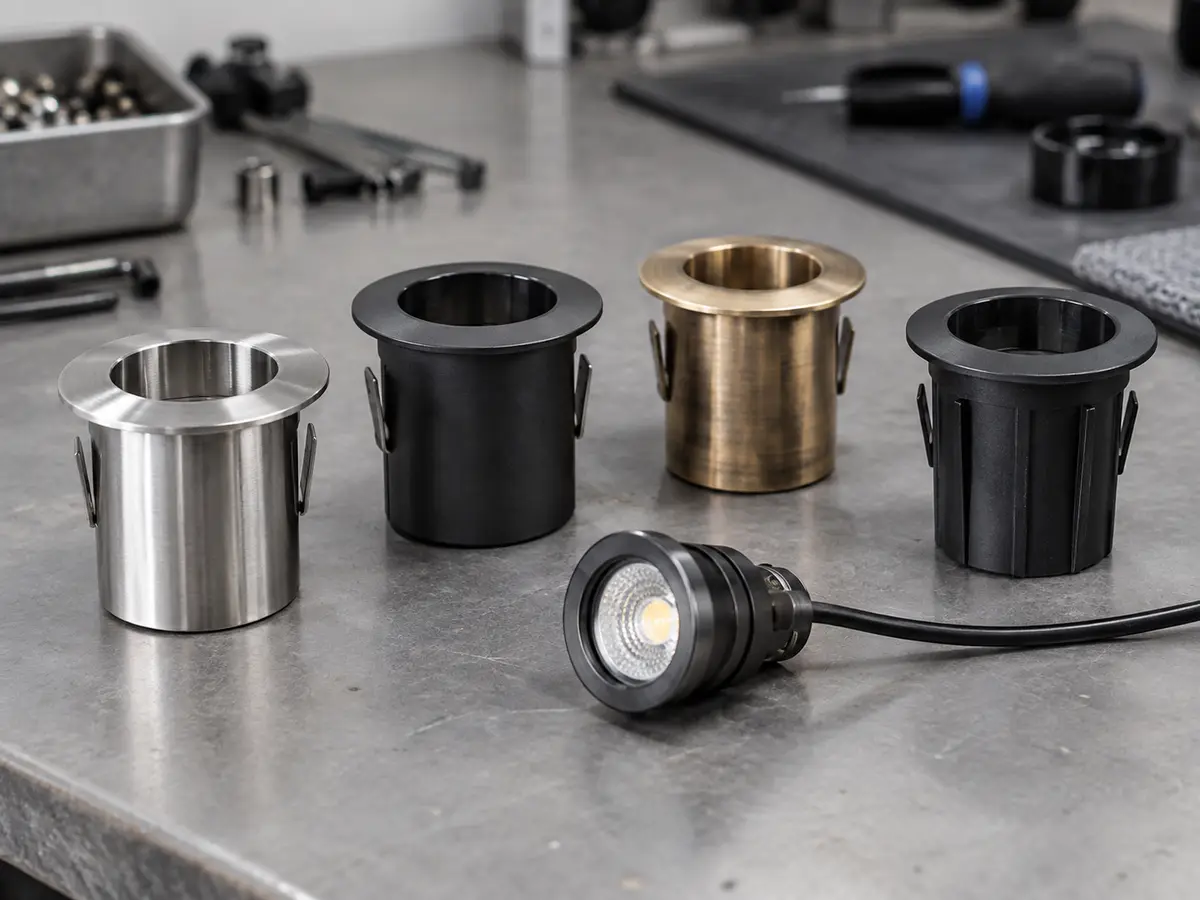
Aluminum: the best default for most compact outdoor spotlights
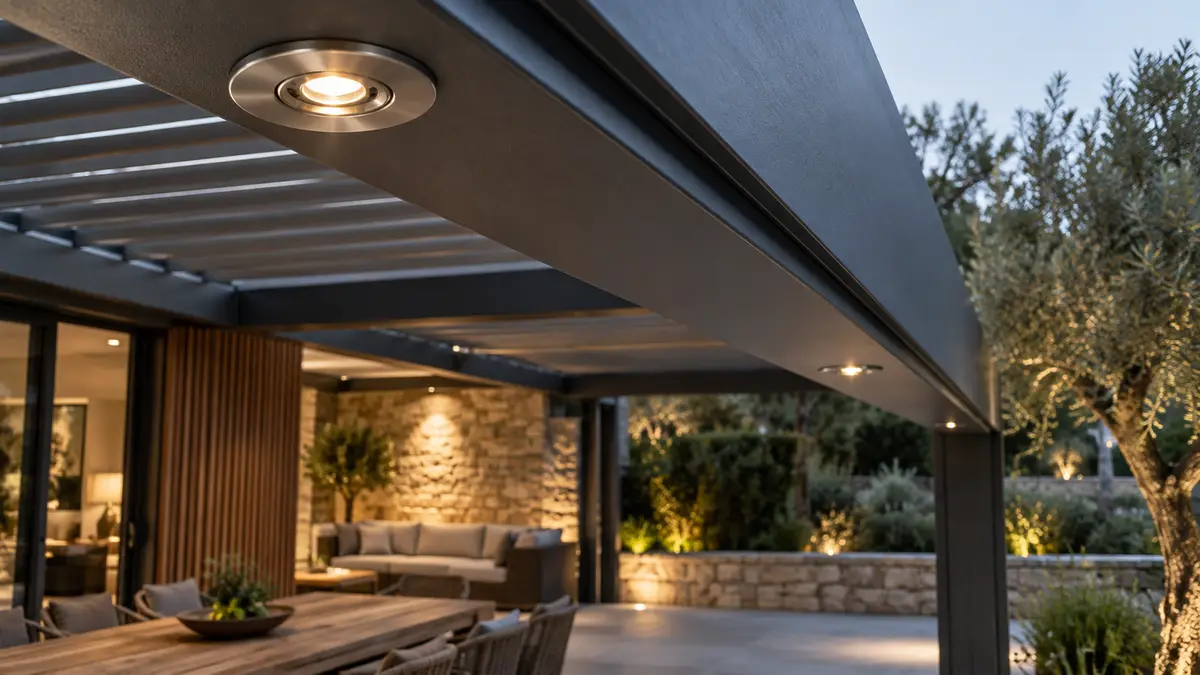
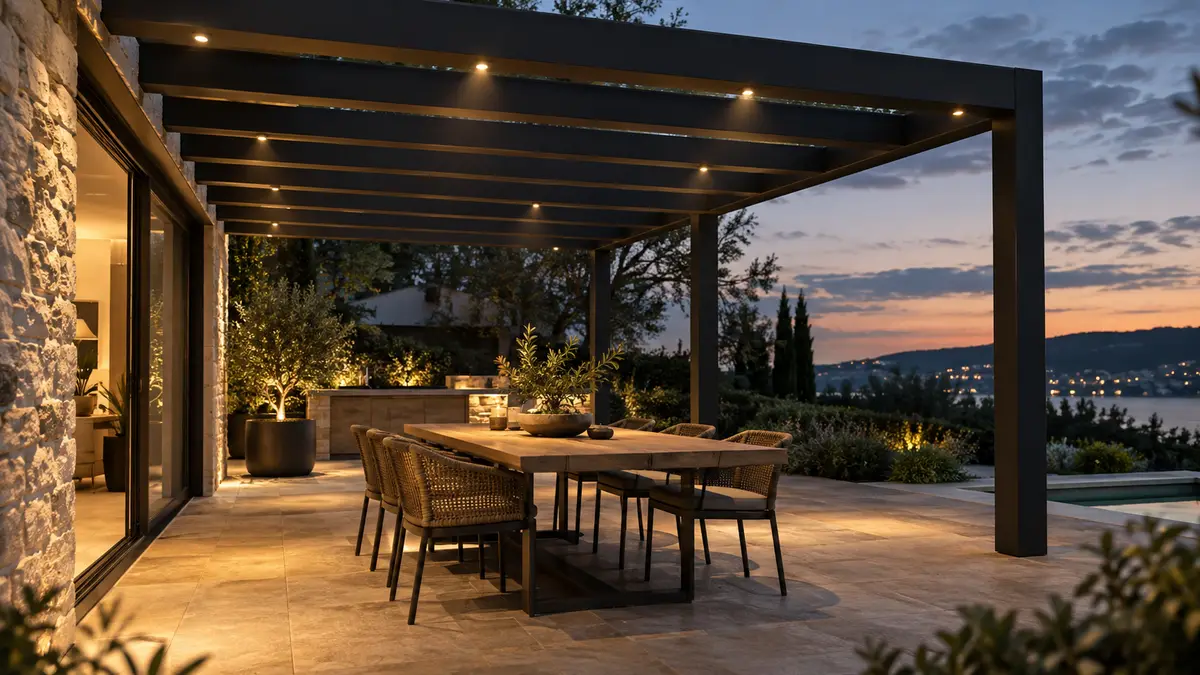
Aluminum is the most versatile choice when the fixture needs to be small, light, thermally competent, and commercially scalable. It is especially well suited to recessed mini spotlights installed in pergola beams, veranda ceilings, awnings, soffits, patio structures, and architectural details where the mounting surface has a limited load capacity.
Its strongest advantage is not simply that it is inexpensive. It is that aluminum can combine a useful thermal path with efficient manufacturing. A die-cast or machined aluminum body can be designed around the LED board, lens, spring, cable exit, and sealing interface without making the product unnecessarily heavy. That matters when a brand sells a three-light to twelve-light kit or when dozens of fixtures are installed overhead.
Where aluminum performs well
- Recessed fixtures where the body must transfer heat into the surrounding cavity.
- Low-voltage 12 V or 24 V products with compact optics and dimming electronics.
- Projects where the fixture finish must match a pergola, awning, trim, or architectural color system.
- OEM products that need repeated dimensions, controlled cutouts, and reasonable tooling economics.
Aluminum is not automatically outdoor-proof. The alloy, wall thickness, coating system, pretreatment, edge coverage, drainage, and contact with other metals all affect performance. A powder-coated body with a damaged edge can behave very differently from a properly pretreated and finished body. For a landscape product exposed to fertilizer, standing water, salt spray, or soil contact, the design should be reviewed more conservatively than a protected spotlight mounted under a roof.
For a compact brand or project range, aluminum also makes specification easier. VLED’s mini LED spotlight range shows how a family can share common electrical and optical logic while varying body dimensions, cutout sizes, fixed or adjustable mounting, IP protection, and control options. The right comparison is not “aluminum versus premium metal” in the abstract. It is whether the chosen aluminum architecture can meet the real installation and service requirements.
Brass: the strongest choice when longevity and outdoor character lead
Brass is a compelling choice for exposed landscape fixtures because it combines corrosion resistance, mechanical strength, useful mass, and a finish that can age without looking like a failed coating. The Copper Development Association describes brass as highly corrosion resistant in atmospheric exposure; its surface can tarnish or develop a patina while the base material remains serviceable.
That behavior is valuable for landscape lighting. A fixture near irrigation, mulch, planting beds, or a coastal property may be difficult to access after installation. When the product is expected to remain in place for years, a stable base metal and durable threaded connection can matter more than the lowest initial unit price.
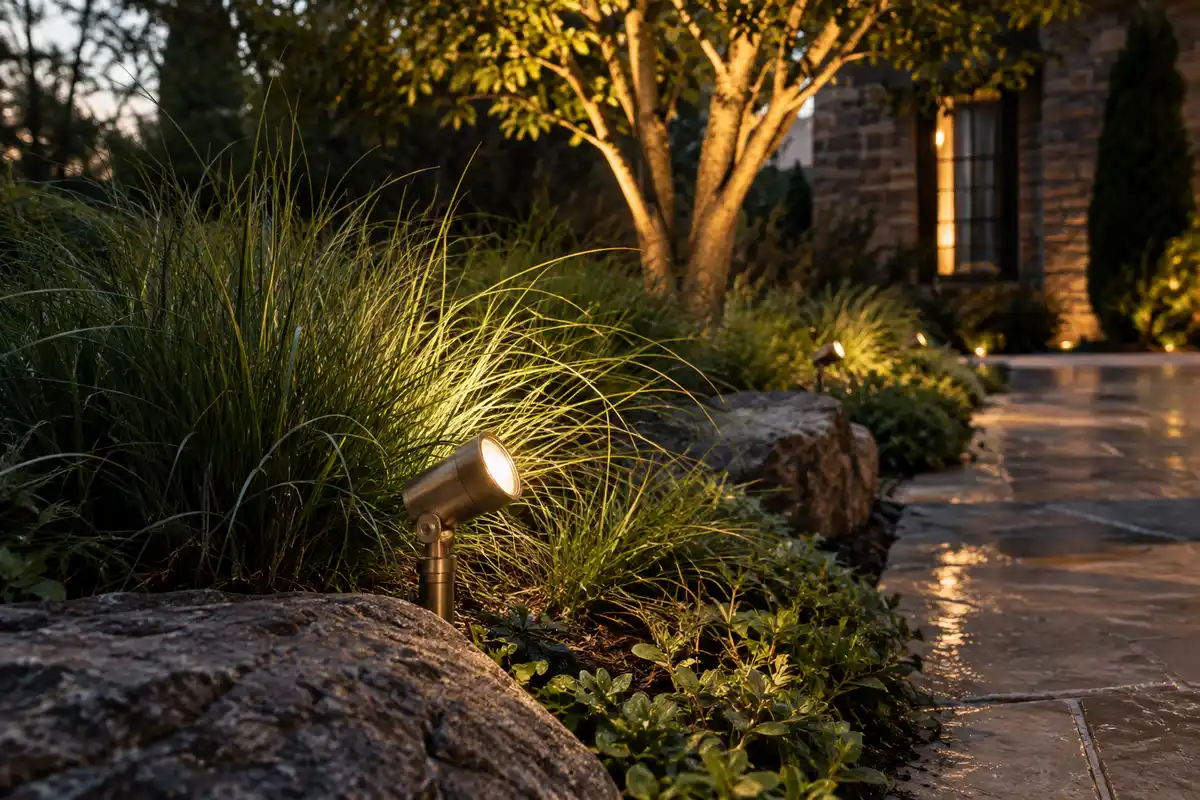
Why project buyers choose brass
- Long-term visual behavior: natural darkening or patina can be part of the design instead of a sign that paint is peeling.
- Mechanical serviceability: brass is well suited to machined threads, caps, adjusters, and fittings that may need to be opened or aimed during maintenance.
- Environmental confidence: it is a strong candidate for exposed landscape and coastal applications when the correct alloy and construction are selected.
- Perceived value: weight and tactile quality support a premium product position for landscape lighting brands.
Brass is not a license to ignore engineering. Specify the alloy, surface treatment, expected appearance, and any requirements related to lead or restricted substances for the destination market. In a saltwater environment, the alloy and the joint design still matter; brass should not be described as immune to every form of corrosion. Also review galvanic contact between brass, aluminum, stainless steel, and fasteners, particularly where water can remain trapped.
Our recommendation is to use brass strategically rather than applying it to every mini spotlight. It is most persuasive where the fixture is visible, exposed, hard to replace, or central to a premium landscape specification. A brass accent ring, threaded bezel, or exposed spotlight body can also be combined with an aluminum thermal core when the optical and mechanical design calls for a hybrid solution.
Stainless steel: strong, clean, and grade-dependent
Stainless steel is often selected because it looks durable. In a professional specification, “stainless steel” is not specific enough. The grade, surface finish, welds, crevices, fasteners, and chloride exposure determine whether the material will continue to look and perform as expected.
Type 304 is suitable for many normal outdoor conditions, while Type 316 offers better resistance in chloride-rich environments because of its molybdenum content. The Nickel Institute notes that chloride accumulation in tight crevices and under deposits can break down the protective surface film; it also identifies 316 as the safer choice when chloride exposure is higher or conditions are uncertain.
Good uses for stainless steel
- Visible trim rings, bezels, faceplates, and architectural details where a clean metallic appearance is important.
- Components exposed to impact, handling, or repeated adjustment.
- Products aimed at modern architectural, hospitality, marine-adjacent, or high-end residential markets.
- Fasteners and small hardware where corrosion resistance and dimensional stability are important.
Stainless steel is usually less attractive than aluminum as the primary heat-spreading body of a very small LED fixture. Its thermal conductivity is lower, and a steel body can add weight without automatically improving the LED’s operating temperature. A practical design may therefore use aluminum for the thermal core and stainless steel for the visible trim or hardware.
Pay special attention to seams and interfaces. A smooth, clean face can still hide a crevice at a bezel, washer, threaded joint, or cable entry. If the product is specified for a coastal project, ask for the exact grade, finish, fastener material, and cleaning or maintenance requirements rather than accepting a generic stainless-steel claim.
Plastic: useful when the application is controlled
Plastic is not one material. Polycarbonate, nylon, PBT, ABS, polypropylene, and reinforced engineering polymers have different temperature limits, UV behavior, impact resistance, dimensional stability, and chemical resistance. A plastic housing can be the right choice for a low-power, lightweight, insulated, or highly integrated product. It becomes risky when it is used to hide an undersized thermal design or when its exposure is left undefined.
The main limitation is thermal. Plastic generally transfers heat much less effectively than metal, so the LED board and internal heat sink must carry more of the thermal burden. For a low-power fixture in a shaded or semi-outdoor location, that may be acceptable. For a tightly sealed, sun-exposed, higher-output mini spotlight, it requires measured temperature validation rather than an assumption.
When plastic can make sense
- Protected indoor and semi-outdoor applications.
- Low-power products where the LED and driver operate well within their temperature limits.
- Insulating parts, cable entries, lenses, diffusers, clips, or secondary covers.
- High-volume products where integrated molding reduces assembly complexity and the service life is clearly defined.
For outdoor use, require the exact polymer grade, UV stabilization, flammability information where relevant, operating temperature range, impact testing, and dimensional stability data. Also inspect threaded areas and spring interfaces. A plastic part may look acceptable in a sample and still creep, crack, discolor, or lose clamping force after years of sun and temperature cycling.
Material selection by application
The best housing changes with the installation. Use the following as a starting framework, then validate the complete fixture in the intended environment.
| Application | Preferred starting point | What to verify before approval |
|---|---|---|
| Recessed pergola or veranda spotlight | Aluminum body, with stainless or coated trim as needed. | Heat path, cavity clearance, cutout tolerance, glare control, cable routing, and finish matching. |
| Premium exposed landscape spotlight | Brass, or aluminum with a proven outdoor finish. | Drainage, threads, aiming mechanism, soil and irrigation exposure, service access, and patina expectations. |
| Coastal or salt-air project | Brass or correctly specified 316 stainless; protected aluminum may suit sheltered positions. | Exact alloy, fasteners, crevices, coating edges, salt exposure, cleaning, and galvanic compatibility. |
| Lightweight private-label product | Aluminum for the main housing; plastic for secondary parts where validated. | Repeatable die casting or machining, color tolerance, documentation, thermal test conditions, and change control. |
| Low-cost protected fixture | Engineering plastic may be viable at low power; aluminum remains safer for heat spreading. | UV, impact, operating temperature, enclosure heat, warranty period, and replacement expectations. |
Do not approve the housing before checking the whole product
A material comparison is useful only when it leads to a controlled purchase specification. Before approving a mini spotlight for a brand range or project, request:
- Exact housing material, alloy or polymer grade, and wall thickness.
- Surface preparation, coating, plating, anodizing, or natural-finish requirements.
- LED board interface, thermal path, measured case temperature, and test ambient.
- IP test basis for the complete delivered configuration, including cable and connector interfaces.
- Dimensions, cutout, mounting depth, spring or clip force, and adjustment range.
- Optical data for the selected lens, beam angle, CCT, and LED configuration.
- Fastener material and galvanic compatibility with the housing.
- UV, salt spray, humidity, temperature-cycle, or impact evidence appropriate to the application.
- Golden sample, production tolerances, batch traceability, and change-notification rules.
VLED’s custom mini LED spotlight options are a useful reference for the scope of a real OEM discussion: housing, finish, cable, connector, packaging, and other details should be treated as part of the product definition. For specification work that also involves beam angle, glare, and placement, see the pergola and gazebo mini spotlight guide.
Our material verdict
If one material must be selected for a broad mini spotlight product family, choose aluminum first and engineer it properly. It offers the most practical balance for compact LED thermal management, low-voltage products, concealed installation, scalable manufacturing, and controlled finishes.
Choose brass when the project rewards long-term outdoor character, mechanical weight, durable threads, and a premium service life. Choose stainless steel when the visible surface, strength, or chloride exposure justifies the added specification discipline, and use the correct grade rather than relying on the word “stainless.” Choose plastic only when its thermal, UV, impact, and dimensional limits match the actual application and warranty promise.
The professional question is not “Which housing material is strongest?” It is “Which housing architecture will keep the light thermally stable, visually consistent, mechanically serviceable, and commercially supportable in this installation?” That is the standard we recommend to lighting brands, pergola manufacturers, wholesalers, and engineering customers.
Need a mini spotlight housing for a specific project?
Share the application, mounting method, target environment, voltage, power, finish, cutout, beam angle, control system, and expected order quantity. VLED’s design and manufacturing team can help evaluate the housing direction and develop a project-ready mini LED spotlight or complete kit.
Contact VLED for a technical quotation and sample discussion.
Send Us Your Request