




Quick Verdict
- Choose recessed mini LED spotlights when the surface can be drilled accurately, foot traffic matters, and a flush architectural finish is part of the project value.
- Choose surface-mounted mini LED spotlights when the project is a retrofit, the substrate is hard to cut, aiming flexibility matters, or maintenance access is more important than a hidden fixture.
- For B2B programs, the strongest offer is usually not one style. It is a coordinated recessed and surface-mounted range with shared voltage, optics, finishes, drivers, splitters, and cable accessories.
Most comparisons between recessed and surface-mounted deck lights stop at a simple idea: recessed lights look clean, while surface-mounted lights are easier to install. That is true, but it is not enough for a lighting brand, patio system supplier, importer, or contractor managing a real outdoor project.
Mini LED spotlights sit in a difficult zone. They are small enough to disappear into a deck board, stair riser, pergola beam, planter edge, or garden wall, but they still have to manage water, heat, voltage drop, impact, glare, color consistency, and future replacement. A poor mounting choice does not only affect aesthetics. It can slow installation, increase claims, complicate inventory, and make a premium outdoor space feel unfinished at night.
From a manufacturer’s point of view, the best decision is made before the product is quoted. Start with the surface, the beam task, the wiring route, the expected service access, and the customer’s tolerance for visible hardware. Then decide whether recessed, surface-mounted, or a mixed system is the right specification.
Why Mounting Style Is a Business Decision, Not Just a Design Choice
Mounting style determines how much risk moves from the factory to the installer. Recessed fixtures demand accurate cutouts and better planning. Surface-mounted fixtures reduce cutting risk, but they expose more of the product to view, contact, cleaning, and design judgment.
For homeowners, that may feel like a taste question. For B2B buyers, it is a margin question. A deck light that requires a 29 mm or 32 mm cutout needs matching drilling tools, packaging instructions, cable routing, and tolerance control. A surface-mounted spotlight needs a clean base, stable fastening, careful cable exit design, and a housing finish that still looks intentional after installation.
This is why experienced buyers often ask for a family of products rather than a single model. On the VLEDSTAR site, the mini LED spotlights range includes recessed, tilting, fixed, and surface-mounted options across different diameters, voltages, CCTs, beam angles, and finishes. That structure matters because projects rarely use one mounting condition everywhere.
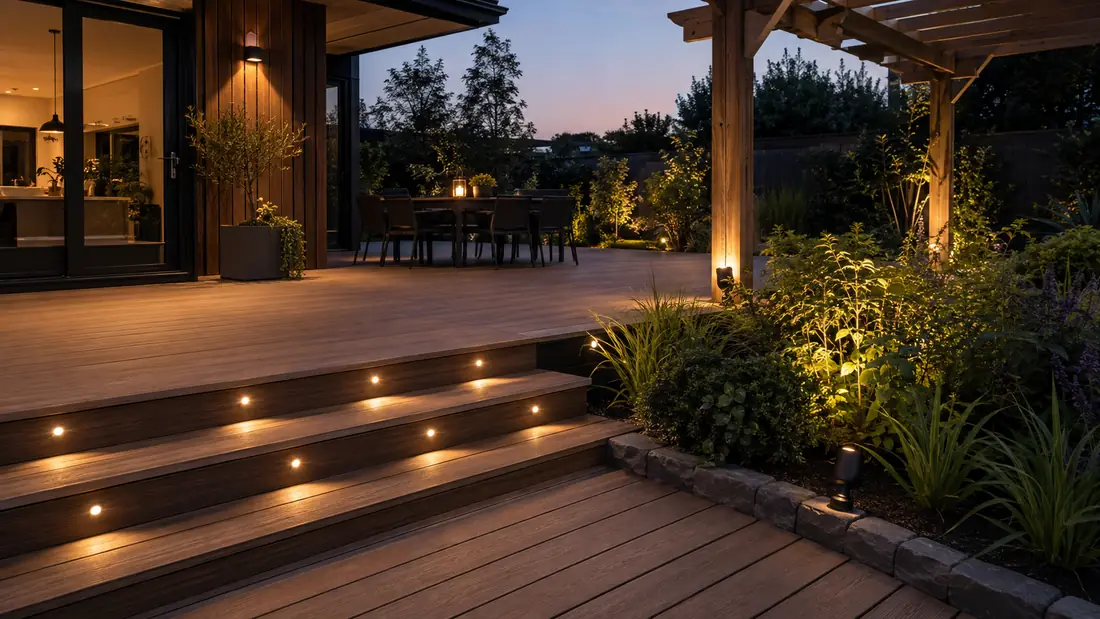
A residential deck may need flush recessed lights on the walking surface, low-glare step lights on risers, and small surface-mounted spotlights under a pergola beam. A hotel courtyard may need one finish family across timber, stone, metal, and concrete. A wholesale program may need the same visual language, but with different SKUs for new build and retrofit channels.
Recessed vs Surface-Mounted Mini LED Spotlights: Quick Comparison
Recessed mini LED spotlights win when integration and pedestrian comfort are the priority. Surface-mounted mini LED spotlights win when flexibility, retrofit speed, and service access matter more. The table below shows the decision points that affect project success after the purchase order is placed.
| Decision Factor | Recessed Mini LED Spotlights | Surface-Mounted Mini LED Spotlights |
|---|---|---|
| Best use case | Deck boards, stair risers, pathway edges, low-profile garden walls, premium architectural details | Retrofit projects, pergola beams, soffits, posts, stone walls, planters, cabinets, display edges |
| Visual effect | Flush, discreet, integrated into the surface | Visible fixture, can look technical or decorative depending on finish and base design |
| Installation risk | Higher because cutout size, depth, substrate thickness, and cable route must be correct | Lower because no deep cutout is usually required, but fastener position and cable exit still matter |
| Maintenance access | More difficult if the fixture is tightly fitted or sealed into a deck, stone, or stair assembly | Easier to inspect, remove, reposition, or replace |
| Foot traffic | Better for walking zones when the product is designed for the surface and load condition | Better away from direct foot traffic, such as vertical faces, beams, rails, or edges |
| Optical control | Excellent for subtle orientation light, edge glow, and low-profile markers | Excellent for adjustable accent, plant lighting, wall grazing, and target-specific beams |
| Procurement logic | Best for planned construction and premium integrated systems | Best for retrofit, mixed-material sites, and fast installation programs |
Where Recessed Mini LED Spotlights Make the Strongest Case
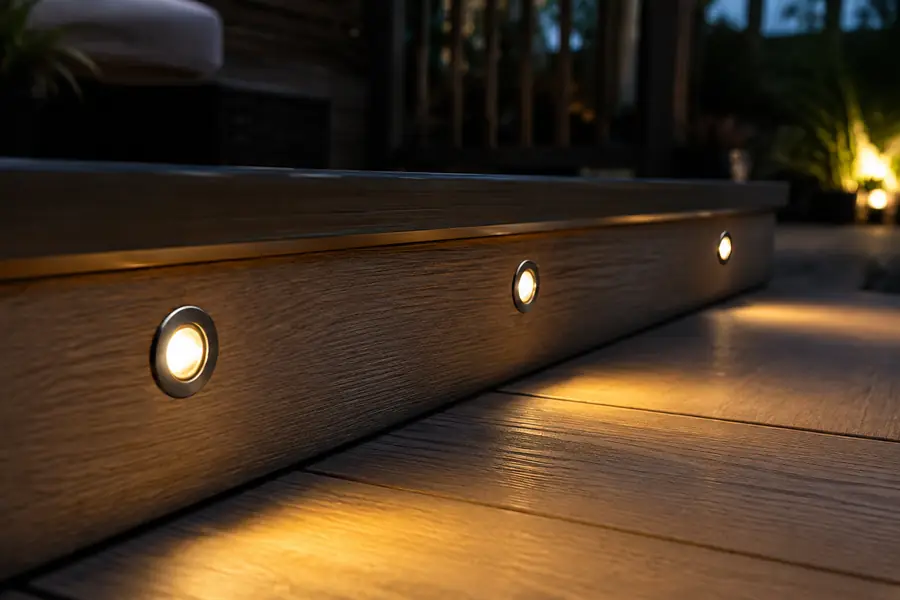
Recessed mini LED spotlights are strongest when the lighting should feel built into the deck, step, or garden structure. They reduce visual clutter, protect the fixture profile, and make the surface read as one designed system rather than a collection of parts.
On decks, this matters because users look down while walking. A raised fixture in the wrong place can catch shoes, furniture legs, cleaning tools, or snow shovels. Flush mounting also helps the lighting feel more permanent, which supports premium positioning for composite deck brands, high-end garden installers, and outdoor living showrooms.
Recessed fixtures also work well when the light is meant to mark an edge rather than flood a space. A small 1W to 3W point can define a stair line, deck perimeter, or garden path without turning the area into a commercial corridor. That approach matches the Five Principles for Responsible Outdoor Lighting from DarkSky International and the Illuminating Engineering Society, which emphasize useful, targeted, low-level, controlled, and warm-colored outdoor light.
The trade-off is installation discipline. A recessed deck light needs a clean cutout, correct depth, stable backing, protected wiring, and room for the cable connector. If the hole is too loose, the fixture can shift. If the hole is too tight, service can damage the housing or finish. If the board expands and contracts, the mechanical fit becomes part of the reliability story.
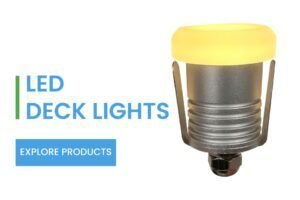
For this reason, recessed products should be sold as a system where possible. On VLEDSTAR’s LED deck lights category, models are presented with details such as power, DC12V or DC24V input, IP rating, color temperature range, cutout size, and installation type. Those details are not only catalog data. They are the information a project buyer needs to reduce installation mistakes.
Where Surface-Mounted Mini LED Spotlights Are the Smarter Choice
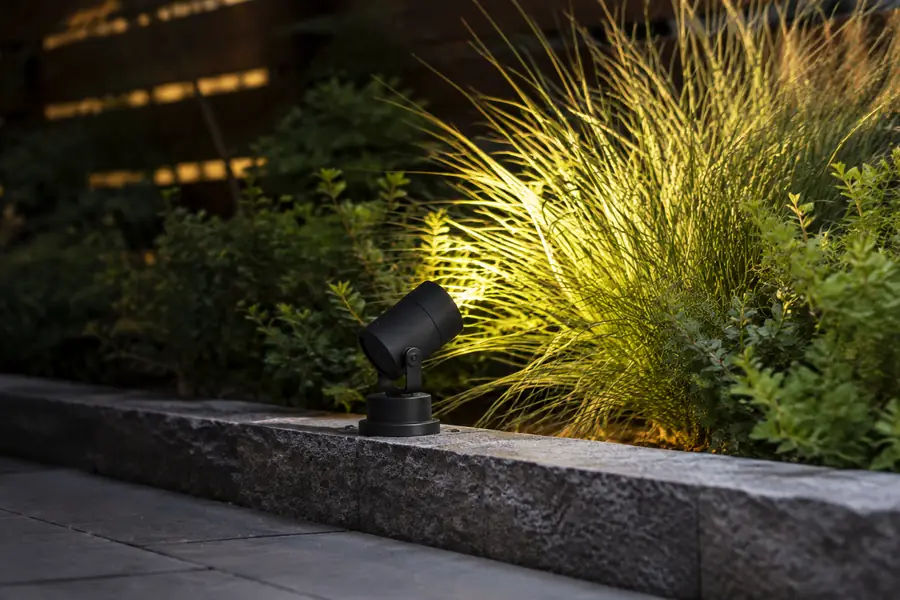
Surface-mounted mini LED spotlights are smarter when the project cannot accept drilling risk, when the fixture may need adjustment, or when the substrate is too thin, too hard, too expensive, or too finished to cut cleanly.
Retrofit work is the obvious case. Many decks, pergolas, stair structures, and gardens were not designed with lighting cavities. Running cable behind an existing wall or through a finished stone edge can cost more than the fixture itself. A surface-mounted spotlight can often be fixed to a post, beam, riser face, soffit, planter, or wall with less disruption.
Surface mounting also gives specifiers more freedom with aiming. A flush recessed light usually sends light in a fixed direction. A surface-mounted mini spotlight can highlight a plant, texture, sculpture, water feature, signage point, or walking transition. For garden and hospitality projects, that flexibility is valuable because plants grow, furniture moves, and nighttime viewing angles change with use.
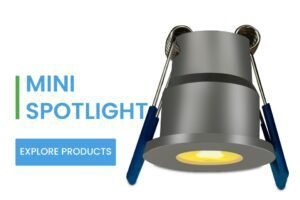
The cost is visibility. Surface-mounted products must look deliberate. The base cannot feel like an afterthought. The cable exit should be controlled. The finish should match the surface or create a clean contrast. VLEDSTAR’s DROVER surface-mounted mini LED spotlight, for example, uses a compact 3W form with DC12V or DC24V options, multiple beam angles, dimming support, and finish choices such as silver, black, white, brushed nickel, or custom RAL color.
That type of product is useful for brands building a system offer. The same buyer may need recessed deck lights for new construction and surface-mounted mini spotlights for add-on zones. If the two families share LED quality, CCT options, connectors, drivers, and packaging logic, the importer can simplify training and after-sales support.
Decks: The Main Issue Is Not Brightness
Deck lighting fails when it is too bright, badly spaced, or installed where people interact with the surface. The best deck specification uses low-output points, warm CCT, and consistent spacing so people understand edges without seeing harsh glare.
Professional deck buyers usually ask about spacing, IP rating, low-voltage kits, cutout tools, and the choice between recessed and surface-mounted products. That is the right instinct. A deck light program should help the installer plan before drilling, confirm perimeter spacing, match the driver and cable system, and understand where each mounting style belongs.
For professional buyers, the missing layer is risk control. A recessed product may look perfect in a sample board but fail commercially if the cutout tool is inconsistent across installers. The accessory package matters. The drilling size, cable length, splitter configuration, transformer capacity, and waterproof connector quality all affect project outcomes.
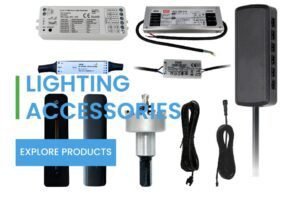
A practical deck program should include recessed IP65 or IP67 deck lights for walking surfaces, spare hole saws or cutout guidance, extension cables, splitters, and driver options. VLEDSTAR’s accessories range supports this kind of system thinking with wires, cables, splitters, power supplies, and hole-saw related products.
Steps: Glare Control Beats Raw Output
Step lighting should help people read the next tread without forcing them to look into the LED. In many stair applications, a lower-output recessed or shielded fixture performs better than a brighter exposed point because the eye adapts quickly in outdoor darkness.
The common mistake is treating step lights like miniature floodlights. More lumens can create more contrast, but not always more safety. If a light is placed at eye level for someone climbing the stairs, or if a polished tread reflects the LED point, the user sees glare before they see the step edge.
Recessed step lights work well in risers, side walls, and deck edges when the beam is directed toward the walking plane. Surface-mounted step lights make sense where the riser cannot be cut, where a stair system is already built, or where service access is more important than a perfectly flush face. In both cases, beam angle and lens type matter. Frosted, beaded, honeycomb, or half-frosted lenses can soften the output compared with a raw clear lens.
For kit-based business, the LED step light kits category is especially relevant. Kits help importers and project buyers reduce mismatch between lamps, cables, controllers, and power supplies. They also make it easier to sell repeatable 3-piece, 6-piece, or 12-piece configurations for stairs, patios, and garden paths.
Gardens: Surface Mounting Often Wins Because Nature Moves
Garden lighting is less fixed than deck or stair lighting. Plants grow, seasonal containers move, stonework shifts, and the best viewing angle changes after landscaping matures. Surface-mounted mini LED spotlights often win because they can be repositioned or aimed with less construction work.
A recessed garden light can be beautiful in a stone wall, planter edge, hardscape border, or pathway detail. It gives a clean architectural point and protects the fixture from casual impact. However, once it is cut into a surface, the beam direction and service method are mostly locked.
Surface-mounted mini spotlights are useful for planting beds, pergola posts, screens, water features, and hospitality gardens because they give the designer more control after installation. A narrow 10 degree or 15 degree beam can pick out a trunk or column. A wider 45 degree or 60 degree beam can soften a planting area. A 2700K or 3000K source usually feels warmer and less intrusive in residential gardens, while commercial outdoor areas may use different CCTs depending on brand tone and safety needs.
DarkSky’s guidance to use light only where needed, at the lowest useful level, with warmer color where possible, is useful here. In garden lighting, a small well-aimed fixture often beats a larger light placed in a convenient but careless position.
Waterproofing, Voltage, and Compliance: What Buyers Should Check
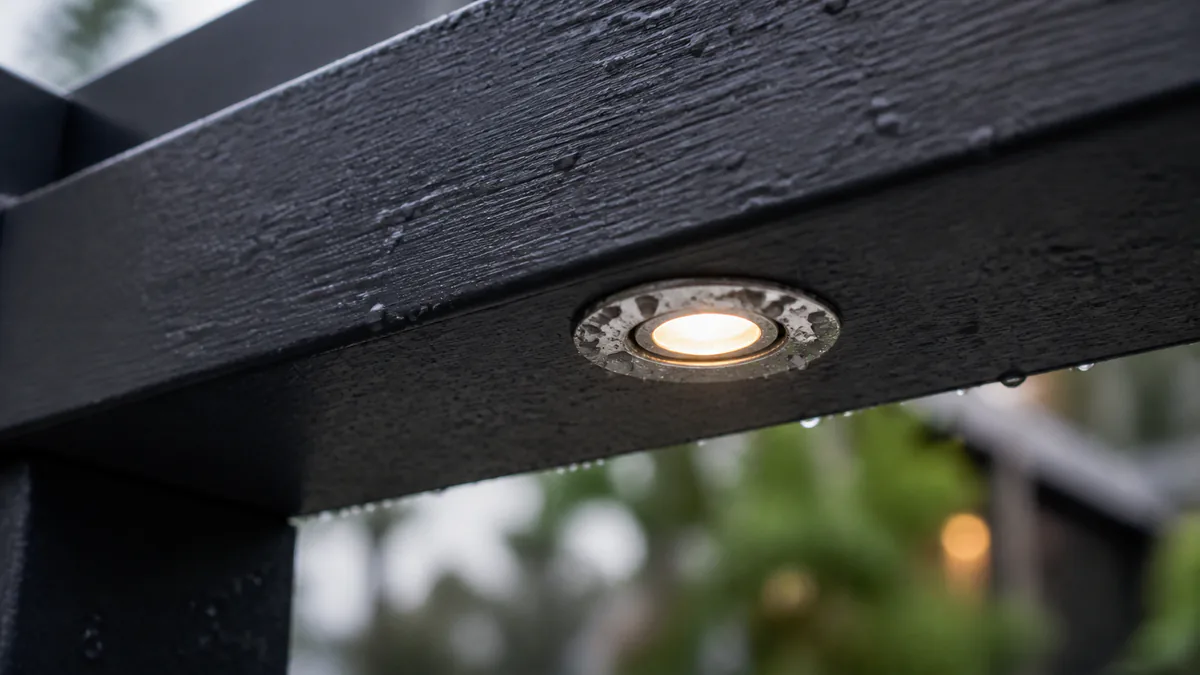
Outdoor mini LED spotlight specifications should be checked as a complete system. IP rating, driver selection, cable connection, voltage, thermal design, installation position, and local code requirements all affect reliability. A waterproof lamp with a weak connector is not a waterproof system.
For decks, steps, and gardens, IP65 is commonly used for protection against dust and water jets, while IP67 is often selected where temporary immersion risk or heavier water exposure is expected. The International Electrotechnical Commission defines ingress protection through IEC 60529, which classifies enclosure resistance against dust and liquids. Still, an IP rating should not be treated as permission to install a standard deck light in a pool, spa, or permanent fountain.
Low-voltage landscape lighting also has a system dimension. UL Solutions notes that low-voltage luminaires are commonly used for pathways, outdoor patios, and similar locations, and that NEC Article 411 limits power units by circuit. UL 1838 covers low-voltage landscape lighting systems and components, including power units, low-voltage cable or flexible cord, and luminaires for garden, walkway, patio, and similar outdoor locations. For U.S. projects, buyers should review the current local adoption of electrical codes with qualified professionals.
Voltage choice is another commercial detail. DC24V is often preferred in longer runs because it can reduce voltage drop compared with lower-voltage systems, but the correct answer depends on cable length, wire gauge, wattage, driver loading, and control method. DC12V remains common in many landscape and deck systems because it fits existing accessories and installer habits. A supplier should be able to explain both.
Optics and CCT Decide Whether the Installation Feels Premium
The mounting style controls how the fixture meets the surface, but optics control whether the light feels expensive. Beam angle, lens texture, glare control, CCT, CRI, and dimming behavior often matter more at night than the housing shape.
A recessed deck marker with a 120 degree glow can define a perimeter. A narrow recessed beam can look dramatic but may create hotspots if spacing is too wide. A surface-mounted spotlight with 10 degree optics can accent a feature, while 45 degree or 60 degree optics can create softer ambient emphasis. In commercial garden projects, using multiple beam options within one product family gives the designer more control without changing the whole procurement package.
CCT should follow the environment. Warm white options such as 2700K or 3000K usually suit decks, steps, gardens, pergolas, and hospitality terraces because they reduce visual harshness. Tunable white, RGB, RGBW, or RGB+CCT options can be useful for branded venues, events, or premium residential scenes, but they need clear control logic. Too much color capability without a good controller can create support problems for wholesalers.
VLEDSTAR product pages commonly list 2700K to 6500K options, RGB/RGBW variants, dimming, multiple beam angles from narrow to wide, and CRI options above 80Ra or 90Ra depending on model. That variety is useful only when the project brief is clear. Otherwise, too many options slow selection.
A Better Framework for Brands, Importers, and Project Buyers
The strongest specification framework is not recessed versus surface-mounted. It is traffic zone, substrate, beam task, service access, and product family fit. That sequence protects the buyer from choosing a beautiful sample that becomes a difficult jobsite product.
1. Start with the traffic zone
If people walk, drag furniture, clean, shovel snow, or roll equipment across the surface, start with recessed or very low-profile products. If the fixture sits on a vertical face, beam, wall, planter, or underside, surface mounting becomes more attractive.
2. Read the substrate before choosing the fixture
Timber, composite decking, aluminum pergola profiles, porcelain tiles, stone, concrete, and brick do not tolerate mistakes in the same way. Recessed lighting is excellent when the material can be drilled cleanly and repeatably. Surface mounting is safer when the substrate is finished, thin, brittle, or expensive to replace.
3. Define the beam task
Marker light, step safety, plant accent, wall texture, product display, and mood lighting are different tasks. Recessed fixtures are often better for subtle markers. Surface-mounted fixtures are often better for aiming and accent.
4. Plan service before installation
Ask how the fixture will be replaced after two or five years. If a contractor must remove decking boards or break sealant to access a failed point, the original quote did not capture the real cost. Accessible connectors and modular kits reduce that risk.
5. Keep the product family coherent
For distributors, the best product line is easy to explain. Shared voltages, similar finishes, compatible cables, matching drivers, and clear kit quantities reduce training time and support tickets. This is where a manufacturer with R&D and production control can make the difference.
How VLEDSTAR Fits This Type of Project
VLEDSTAR is useful for buyers who need mini LED spotlight development and production support, not only a single off-the-shelf deck light. The company history on the Over VLED page traces LED business activity back to 2010, factory production from 2015, a focus on mini LED spotlight sets from 2016, and R&D and quality management development from 2017.
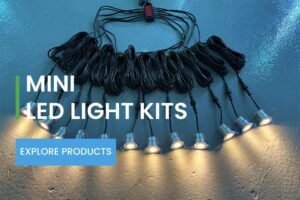
That background matters for recessed and surface-mounted product planning. A brand may need a compact recessed model for deck boards, a surface-mounted model for pergola or garden accents, an IP65 step light kit, and accessories that fit the same packaging and voltage logic. VLEDSTAR’s product structure already points in that direction through mini LED light kits, deck lights, step light kits, power supplies, splitters, extension cables, and multiple spotlight forms.
The manufacturing value is not simply saying “custom available.” It is helping the buyer decide where customization is worth it. Custom RAL finishes, beam angle selection, lens choices, cable length, connector type, driver loading, packaging, and kit quantity can all affect sales success. Some should be customized. Others should stay standardized to protect delivery speed and after-sales clarity.
For buyers comparing manufacturers, the existing article on mini LED spotlight manufacturer comparison can help frame supplier selection. For application inspiration, the pergola lighting ideas page is also relevant because pergolas often combine recessed points, surface-mounted spots, and linear lighting in one outdoor system.
Common Mistakes to Avoid
Most project failures come from treating small outdoor lights as simple accessories. The fixture may be small, but the installation environment is demanding. The following mistakes create more problems than the choice of recessed or surface-mounted style itself.
- Choosing recessed lights before confirming cutout diameter, substrate thickness, rear clearance, and cable exit space.
- Using surface-mounted fixtures in walking zones where shoes, furniture, or maintenance tools can hit the housing.
- Specifying IP65 or IP67 lamps without checking connector, splitter, driver, and cable protection.
- Over-lighting steps and decks, which creates glare, hotspots, and a less refined night scene.
- Mixing CCTs across batches without a binning or project-control strategy.
- Selling smart RGB or RGBW systems without clear controller, remote, app, and support documentation.
- Ignoring replacement access, especially on sealed deck boards, stone steps, and built-in garden walls.
Final Recommendation
For decks, steps, and gardens, recessed mini LED spotlights should be treated as the premium integrated choice, while surface-mounted mini LED spotlights should be treated as the flexible and serviceable choice. The best professional programs usually need both.
If the project is new construction, the substrate is predictable, and a flush finish is important, specify recessed fixtures early and coordinate cutouts, cables, splitters, and drivers before installation begins. If the project is a retrofit, the surface is hard to cut, or the lighting target may change over time, choose surface-mounted fixtures with careful attention to finish, base design, and cable routing.
For brands and importers, the bigger opportunity is to stop selling isolated products. Build a coordinated outdoor mini lighting system: recessed deck lights, surface-mounted mini spotlights, step light kits, compatible drivers, waterproof cables, splitters, and clear installation documents. That is the difference between a product that looks good in a sample box and a range that earns repeat orders.
Discuss a Mini LED Spotlight Program
If you are developing a recessed or surface-mounted mini LED spotlight range for decks, steps, pergolas, gardens, or outdoor living systems, share your drawings, target market, voltage preference, IP requirement, finish direction, and expected kit structure with the VLEDSTAR team.
Contact VLEDSTAR to discuss OEM, ODM, kit configuration, beam angle selection, and project-ready accessories for your next landscape lighting program.
Pingback: Mini LED Spotlight Beam Angle Guide for Pathways, Trees, Walls, and Features - miniledspotlight.com
Pingback: Custom Mini LED Spotlights: Housing, Finish, Cable, Connector, and Packaging Options - miniledspotlight.com
Pingback: Small Outdoor Spotlights for Modern Gardens: Design Ideas That Also Help Buyers Specify Fixtures - miniledspotlight.com
Pingback: Mini LED Spotlights for Pergolas and Gazebos: Placement, Glare, and Low-Voltage Planning - miniledspotlight.com