


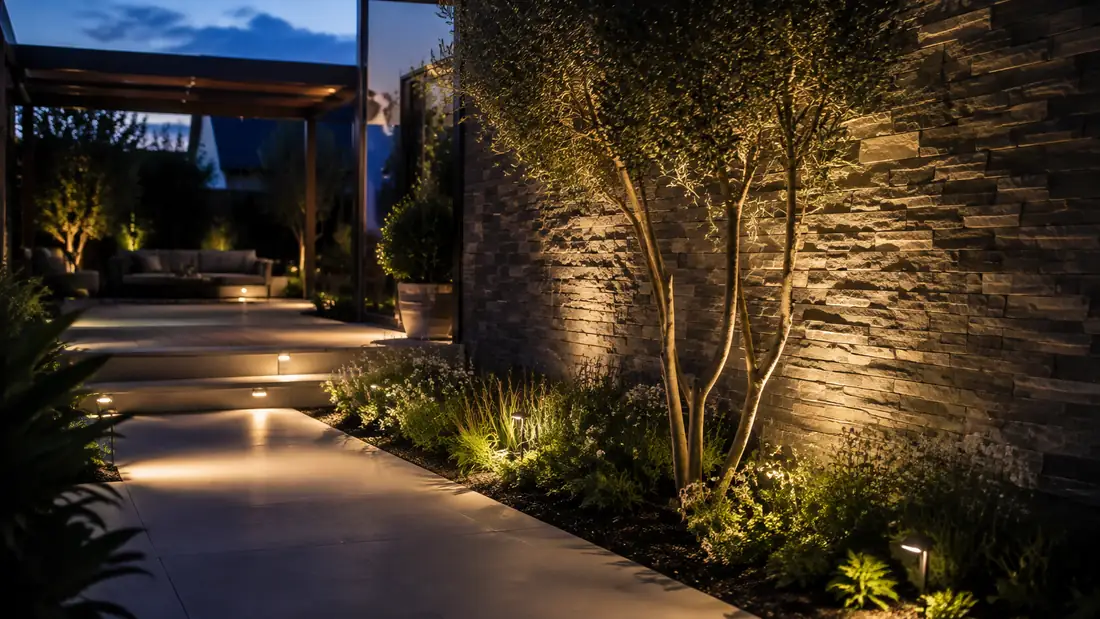
A mini LED spotlight can make an outdoor project feel intentional, premium, and quiet. It can also make the same project look patchy, harsh, or under-specified. The difference is often not wattage. It is beam angle.
For landscape lighting brands, pergola system suppliers, patio product companies, import wholesalers, and project buyers, beam angle should be treated as a commercial specification. It affects how the product photographs, how installers aim it, how many fittings a project needs, how much glare the end user sees, and whether a repeat order matches the first shipment.
Key Takeaways
- Beam angle controls coverage, contrast, glare, and spacing, not only the visible width of light.
- For pathways, 30 to 60 degrees usually gives safer guidance; for trunks and columns, 10 to 25 degrees gives cleaner accents.
- For wall grazing, go narrow and close; for wall washing, go wider and farther back.
- For OEM programs, specify beam angle with mounting depth, distance, CCT, CRI, IP rating, cable system, and sample tolerance.
What Does Beam Angle Really Control?
Beam angle controls the useful cone of light from a fixture. The U.S. Department of Energy notes that LED sources are compact and enable good optical control, which is one reason LEDs can place light more precisely than older lamp types (DOE LED Basics). For mini spotlights, that optical control is the product.
Most buyers ask for a beam angle after they ask for wattage. That order creates weak specifications. A 3W mini LED spotlight with a 15 degree optic and a 3W mini LED spotlight with a 60 degree optic can feel like different products in the same garden.
A narrow beam concentrates intensity. It creates drama, shadow, and visual hierarchy. A wider beam spreads the same output over more area. It softens contrast, reduces hard hotspots, and makes spacing more forgiving.
This is why professional buyers should define the desired effect first. Path guidance, tree uplighting, wall grazing, wall washing, pergola accents, sculpture lighting, and facade details each need a different optical decision.
Beam angle is also a supply-chain decision
In a branded product line, beam angle affects SKU planning. If a catalog includes too many angles, inventory becomes messy. If it includes too few, installers cannot solve real sites.
A practical mini spotlight family often needs a narrow accent beam, a medium general accent beam, and a wide wash option. On VLED’s mini LED spotlights category page, product filters include beam angles from 5 degrees to 120 degrees. That range matters because outdoor projects rarely behave like showroom boards.
How Do You Calculate Beam Spread?
Beam spread is the projected diameter of the beam at a given distance. A simple geometry formula lets buyers estimate coverage before sampling. The formula is not a substitute for photometric testing, but it prevents obvious mismatches between target size and fixture spacing.
Beam diameter = 2 x distance x tan(beam angle / 2)
If a spotlight is 1 meter from a wall and has a 30 degree beam, the projected beam diameter is about 0.54 meters. At 2 meters, the same beam reaches about 1.07 meters. The angle stayed the same, but the visible coverage doubled.
| Beam angle | Approx. beam diameter at 1 m | Approx. beam diameter at 2 m | Typical outdoor use |
|---|---|---|---|
| 10 degrees | 0.17 m | 0.35 m | Narrow tree trunks, columns, small statues, long-distance accents |
| 15 degrees | 0.26 m | 0.53 m | Focused uplighting, narrow features, sharper architectural accents |
| 25 degrees | 0.44 m | 0.89 m | Small trees, planters, textured wall grazing, feature lighting |
| 35 degrees | 0.63 m | 1.26 m | Medium shrubs, garden features, general accent lighting |
| 60 degrees | 1.15 m | 2.31 m | Soft wall wash, pathway edges, broad planting beds, pergola ambience |
| 80 degrees | 1.68 m | 3.36 m | Wide wash, low-contrast background lighting, shallow mounting distances |
Real beam appearance depends on lens design, LED package, reflector quality, trim depth, surface reflectance, and mounting angle. Two fixtures marked 30 degrees can still look different. For serious projects, request samples and compare them at the same distance, voltage, CCT, and dimming level.
Which Beam Angle Works Best for Pathways?
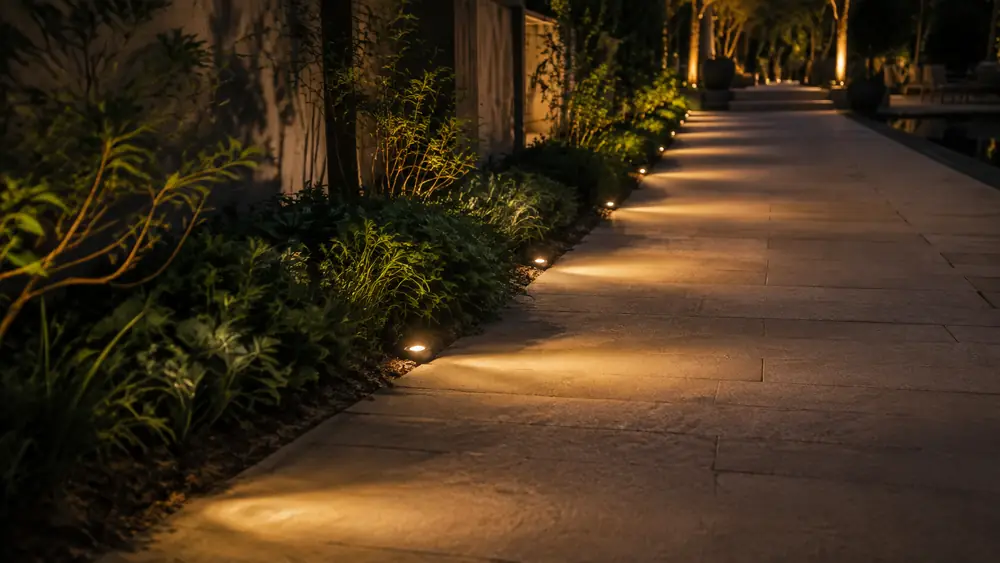
Pathway lighting should guide movement without putting light into the eye. A 30 to 60 degree beam is usually the safer mini spotlight range when the fixture is used for soft edge guidance. The U.S. National Park Service defines outdoor light pollution through glare, light trespass, and skyglow, which makes beam control a practical safety and comfort issue (NPS light pollution guide).
For pathways, the goal is not to create a row of bright circles. The goal is rhythm. People should understand where to walk, where the edge changes, and where a step, planter, wall, or seating area begins.
Mini spotlights can serve pathways in three ways. They can light low planting near the path. They can wash a low wall beside the path. They can mark a feature at the end of the path, which pulls the eye forward.
Use wider beams for guidance
For low-level pathway edges, 45 to 60 degrees often gives the most comfortable effect. The beam spreads enough to reduce harsh dots, and the installer has some aiming tolerance.
If the fixture is close to the walking line, a very narrow 10 to 15 degree beam can create glare. It may look precise in a catalog image, but it can feel aggressive when viewed from standing height.
Use medium beams for nearby planting
When the fixture is aimed at grasses, small shrubs, or low planting beside the path, 25 to 45 degrees is often a better range. It gives enough definition to show texture without creating a hard tunnel effect.
For branded pathway kits, specify beam angle together with mounting height, aiming range, cable length, connector type, and driver capacity. The kit should make installation repeatable, not leave each installer to rebuild the system in the field. VLED’s outdoor mini LED spotlight selection guide covers these system-level choices in more detail.
Which Beam Angle Works Best for Trees?
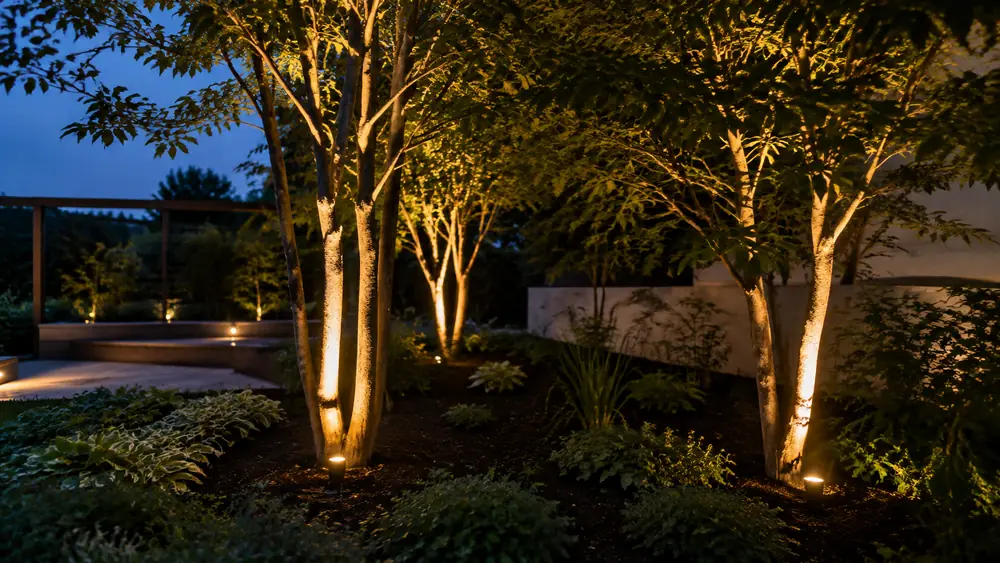
Tree lighting needs the beam to match trunk width, canopy spread, and viewing distance. Use 10 to 25 degrees for narrow vertical drama, 30 to 45 degrees for balanced uplighting, and 60 degrees or wider for soft canopy glow. The larger the tree, the less useful a single angle becomes.
The common mistake is using one spotlight to light the whole tree. That can work for a young ornamental tree, but it usually fails on larger specimens. The trunk becomes too bright, the canopy disappears, or the beam misses the branching structure.
Small ornamental trees
For compact trees near patios, pathways, or pergolas, 25 to 35 degrees is a strong starting point. It gives shape without over-lighting the surrounding area.
If the tree has a narrow trunk and a sculptural canopy, use one 15 to 25 degree beam on the trunk and a second wider beam into the canopy. This creates depth instead of a flat bright patch.
Tall trunks and palms
For tall, narrow trunks, 10 to 20 degrees can be effective. The beam stays tight and carries farther upward. It also helps separate the trunk from nearby planting, walls, or outdoor furniture.
However, narrow beams demand accurate aiming. If the fixture is only slightly misaligned, the hotspot leaves the trunk. For project buyers, this is where adjustable mounting, stake stability, and sample approval become as important as the optic.
Large canopy trees
For broad canopy trees, 45 to 60 degrees often works better than a narrow beam. The objective is to reveal volume. Use multiple lower-output fixtures rather than one harsh high-output fitting.
In hospitality gardens and premium residential outdoor spaces, lower contrast can feel more expensive. A tree should look present after dark, not staged like a display window.
Which Beam Angle Works Best for Walls?
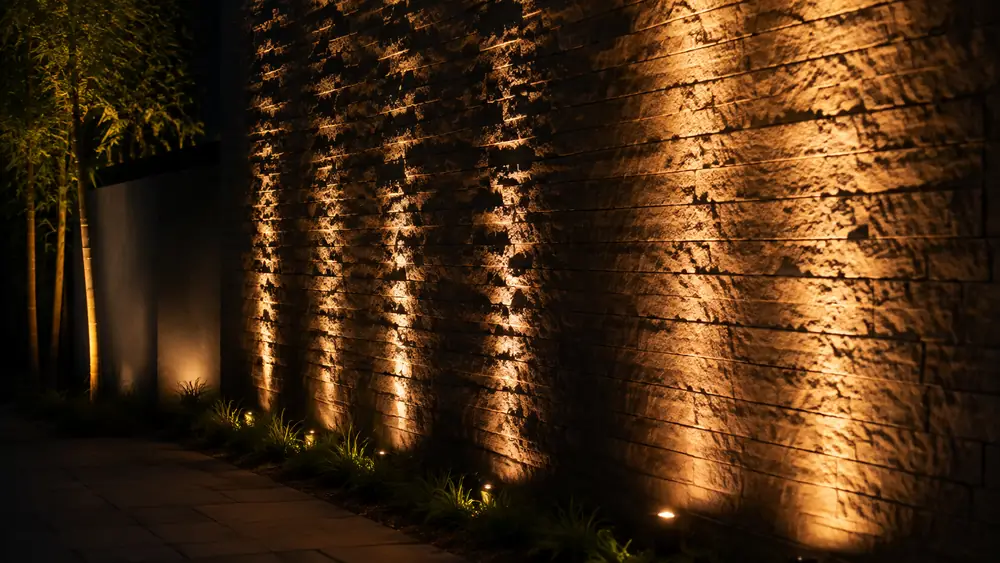
Wall lighting has two different jobs: grazing and washing. Grazing uses narrow to medium beams close to the surface to reveal texture. Washing uses wider beams set farther back to create even brightness. Confusing these two effects is the fastest way to create scallops and complaints.
A brick wall, stacked stone, timber screen, pergola post line, or textured facade often benefits from grazing. A smooth rendered wall, brand sign background, hotel courtyard wall, or privacy screen usually needs washing.
Wall grazing
For grazing, start with 10 to 25 degrees when the fixture sits close to the wall. The narrow beam creates shadow and makes texture visible. The closer the fixture is to the wall, the more dramatic the texture becomes.
This is useful for stone, wood grain, fluted panels, and vertical garden structures. Yet it is less forgiving. Bad spacing creates hard scallops, and a rough fixture finish can become visible if the light source sits in the viewer’s line of sight.
Wall washing
For washing, start with 45 to 80 degrees and move the fixture farther from the wall. The beam needs room to spread. If the fitting sits too close, even a wide optic can create bright bands near the base.
For commercial wall wash orders, ask for test photos at fixed distances. A supplier should show the wall effect, not only the fixture body. If your project needs repeatable wall lighting, pair beam angle with spacing, setback distance, lens type, and expected surface material.
Mounting style also changes the wall result. A recessed mini spotlight can disappear into a pergola beam, ceiling, deck edge, or wall niche. A surface-mounted fixture can be easier to retrofit and adjust. The difference is explained in VLED’s guide to recessed vs surface-mounted mini LED spotlights.
Which Beam Angle Works Best for Features?
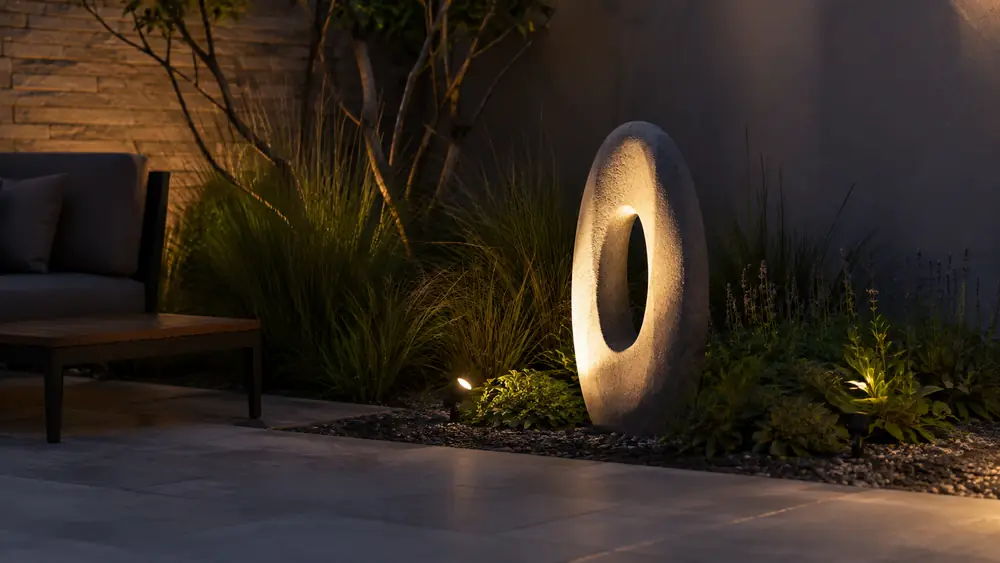
Feature lighting should make the object legible from the main viewing position. Use 10 to 20 degrees for small, narrow, or distant features; 25 to 45 degrees for statues, planters, and signs; and 60 degrees or wider when the feature is broad, close, or intentionally soft.
Features include sculptures, specimen plants, water elements, signage, outdoor kitchens, pergola details, facade niches, seating walls, columns, canopies, and product displays. The right beam angle depends less on the object name and more on the object’s visible size from the viewer’s position.
Small features need precision
A narrow 10 to 20 degree beam works well when the target is small and the background should stay dark. This is useful for a small sculpture, a narrow sign panel, a planter focal point, or a vertical architectural detail.
Precision can also reduce wasted light. That matters in dark-sky sensitive projects, high-end residential work, and hospitality gardens where glare feels cheap.
Medium features need balance
For most garden features, 25 to 45 degrees is the practical middle. It gives enough coverage for installers to aim on site, while still keeping the object more important than the background.
This range is useful for importers because it can cover several catalog scenarios. If a distributor wants one general-purpose mini LED spotlight SKU, a 30 or 35 degree beam is often easier to support than a highly specialized narrow optic.
Integrated outdoor products need kit logic
Pergolas, awnings, patio covers, outdoor cabinets, and modular garden products need lighting that fits the product structure. Beam angle must work with hole size, trim diameter, installation depth, driver position, cable routing, dimming control, and packaging.
For these applications, a complete mini LED spotlight kit can reduce sourcing friction. The fixture, driver, connector, controller, and cable layout can be specified as one product system.
Why Mini LED Spotlights Need Different Beam Thinking
Mini LED spotlights have smaller apertures than traditional landscape uplights. That makes them easier to hide, but it also makes optical design more sensitive. Small changes in lens, trim depth, LED position, and housing geometry can visibly change the beam edge.
This is good news when the product is engineered well. A small fixture can sit inside a pergola beam, soffit, step, deck edge, planter, cabinet, or narrow architectural profile. The light appears to come from the structure, not from a bulky lamp.
It also raises the bar for manufacturing. A sample that uses one lens, one LED bin, and one trim depth must match the production version. If the optic changes quietly during production, the beam changes too.
For outdoor programs, IP rating also belongs in the same conversation. IEC explains IP ratings as protection levels against solid objects and water ingress (IEC IP ratings). For a mini spotlight kit, the exposed cable entry, connector, splitter, and driver enclosure should match the environment, not only the lamp head.
How Should Brands Specify Beam Angle for Production?
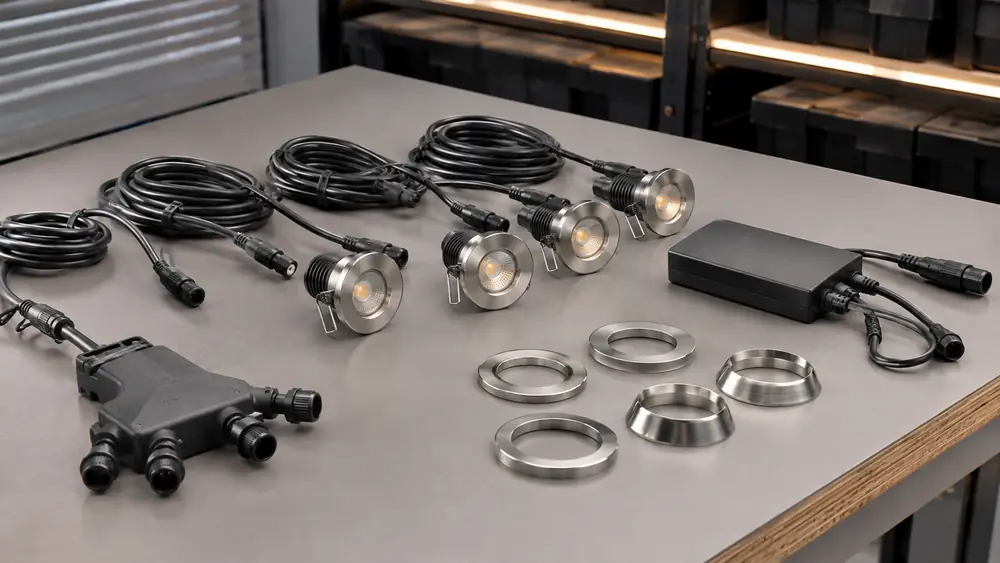
A production specification should describe the lighting effect in measurable terms. Beam angle alone is not enough. The buyer should define target distance, target size, mounting method, CCT, CRI, IP rating, cable system, control method, and approval tolerance before ordering samples.
The reason is simple. A project customer does not complain that the beam angle was wrong. They complain that the pathway is glaring, the wall is striped, the tree looks flat, or the second order does not match the first installation.
Professional buyers can avoid that by treating beam angle as part of an optical package. The supplier should confirm not only the nominal angle, but also the lens type, beam edge, hotspot behavior, dimming response, and color consistency.
| Specification item | What to ask for | Why it matters |
|---|---|---|
| Application | Pathway, tree, wall graze, wall wash, pergola, deck, feature, facade, or signage | The same beam angle can perform differently in each zone. |
| Beam angle | Nominal angle plus sample photo at a fixed distance | Catalog numbers do not show beam edge, hotspot, or spill. |
| Mounting | Recessed, surface-mounted, tilt recessed, stake, trim ring, hole size, and depth | Mounting geometry changes aiming range and glare. |
| Color quality | CCT, CRI, binning tolerance, and batch matching method | DOE explains that CCT and color fidelity are key aspects of LED light quality (DOE LED Basics). |
| Outdoor protection | IP rating for fixture, cable entry, connector, splitter, and driver location | Outdoor reliability follows the weakest exposed part. |
| Electrical system | DC 12V or 24V, driver wattage, dimming method, maximum run length, and cable gauge | Optical consistency suffers when voltage drop or dimming mismatch changes output. |
| Approval standard | Reference sample, production tolerance, inspection photos, packaging, and spare parts | Repeat orders need a repeatable control method, not only a signed sample. |
For buyers building a private-label range, VLED’s OEM mini LED spotlight specification checklist is a useful next step. It turns optical, electrical, mechanical, packaging, and quality-control decisions into a clearer sourcing brief.
Common Beam Angle Mistakes in Outdoor Projects
Most beam angle problems are not caused by lack of options. They come from specifying the fixture without the scene. The buyer chooses a beam from a product list, then discovers the distance, surface, viewing angle, or mounting structure needed a different optical choice.
Choosing by wattage first
Wattage tells you power consumption, not effect. A narrow low-watt fixture may feel brighter than a wider high-watt fixture because the light is concentrated.
Ignoring the viewer’s eye position
A beam that looks good on the target can still be uncomfortable from the patio, pathway, window, or restaurant table. Always judge from the real viewing position.
Using one angle for every zone
A pathway edge, textured wall, tree trunk, and pergola ceiling do not need the same beam. A professional product family should offer enough optics to solve these zones without overcomplicating inventory.
Approving samples without distance control
Sample photos are only useful when distance, angle, CCT, voltage, dimming level, and target surface are known. Otherwise, the photo is a mood image, not a specification record.
Recommended Beam Angle Starting Points
The table below is a practical starting point for mini LED spotlight selection. It should guide sample requests, not replace testing. Final selection depends on fixture output, optic quality, mounting distance, target material, ambient brightness, and local lighting expectations.
| Application | Recommended starting range | Design intent | Specification note |
|---|---|---|---|
| Pathway edge | 45 to 60 degrees | Soft guidance and low glare | Keep output low and aim away from eye level. |
| Pathway planting | 25 to 45 degrees | Texture and depth beside the walking line | Use plant height and fixture setback to choose final angle. |
| Narrow tree trunk | 10 to 20 degrees | Vertical drama and long throw | Requires stable aiming and careful glare control. |
| Small to medium tree | 25 to 45 degrees | Balanced trunk and lower canopy accent | Consider two lower-output fixtures for better depth. |
| Large canopy tree | 45 to 60 degrees or wider | Soft volume and layered glow | Avoid one harsh high-output beam from one side. |
| Textured wall graze | 10 to 25 degrees | Shadow, relief, and surface texture | Control fixture spacing to avoid harsh scallops. |
| Smooth wall wash | 45 to 80 degrees | Even background brightness | Use enough setback for the beam to blend. |
| Small feature | 10 to 25 degrees | Precise focus and darker surroundings | Best for signs, sculptures, columns, and narrow details. |
| General garden feature | 25 to 45 degrees | Useful accent with installer tolerance | A strong option for distributor stock programs. |
| Pergola or outdoor structure detail | 30 to 60 degrees | Integrated ambience and task support | Coordinate beam with mounting depth, cable route, and controller. |
How to Turn Beam Angle into a Better Product Line
A strong mini LED spotlight range should not chase every possible angle equally. It should organize beam angles around real customer use. That makes the product line easier to sell, stock, install, and support.
For many European and North American outdoor-lighting channels, three optical groups are enough for the first range. Offer a narrow accent beam for trees and features, a medium accent beam for general landscape use, and a wide beam for walls, pathways, and integrated outdoor living structures.
Then build the rest of the specification around those optical groups. Match each beam group with wattage, housing size, trim style, IP rating, CCT options, CRI target, finish, cable length, connector type, driver, dimming method, and packaging.
VLED develops and manufactures mini LED spotlights, low-voltage light kits, pergola lighting solutions, deck lights, and related accessories for brand and project customers. The company history on the VLED factory profile shows the manufacturing focus behind these product families, including R&D, quality management, and OEM/ODM support.
For buyers comparing specific fixtures, IP65 recessed models such as the DELUXE 3W IP65 mini LED spotlight, DEER 3W IP65 mini LED spotlight, DRAGON 3W IP65 mini LED spotlight, and DIAMOND 3W IP65 mini LED spotlight give a useful starting point for outdoor-oriented sample discussions.
FAQ
What beam angle is best for pathway mini LED spotlights?
For pathway guidance, 30 to 60 degrees is usually more comfortable than a very narrow beam. Use the wider end when the fixture sits close to the walking line. Use 25 to 45 degrees when the spotlight is aimed at planting or a low wall beside the path.
What beam angle should be used for tree uplighting?
Use 10 to 25 degrees for narrow trunks, columns, and tall vertical accents. Use 30 to 45 degrees for small and medium trees. Use 60 degrees or wider for broad canopy glow, especially when the aim is soft volume rather than strong contrast.
What is the difference between wall grazing and wall washing?
Wall grazing places the fixture close to the wall and uses a narrow to medium beam to reveal texture. Wall washing places the fixture farther away and uses a wider beam to create even surface brightness. The two effects need different spacing and aiming.
Is 3W enough for outdoor mini LED spotlights?
For many accent, pergola, pathway, planter, step, and small feature applications, 3W can be enough when the optic is correct and the viewing distance is reasonable. Wattage should be evaluated together with beam angle, lumen output, CCT, surface color, and ambient light.
Should importers request photometric files?
For standard catalog resale, controlled sample photos may be enough at the first stage. For engineering projects, retail programs, or branded OEM ranges, photometric data is useful because it helps designers compare intensity distribution, spacing, and beam behavior more objectively.
Need a Beam Angle Recommendation for a Real Project?
Send the application, target size, mounting distance, installation type, voltage, CCT preference, IP requirement, and expected order model. The right mini LED spotlight beam angle can then be specified around the effect your customer needs, not around a guess from a catalog table.
For OEM, wholesale, pergola, patio, garden, and outdoor project inquiries, contact the VLED team through the mini LED spotlight project inquiry page.
Pingback: Mini LED Spotlights for Pergolas: Placement & Glare