







Key takeaways
- Use 2700K as the default for relaxed patios, pergolas, dining, timber, brick, and guest-facing hospitality areas.
- Use 3000K when a project needs a cleaner architectural appearance, stronger plant definition, or a balance between ambience and practical visibility.
- Reserve 3500K to 4000K for screened task, cleaning, service, or security zones with separate controls.
- Specify CCT together with CRI or TM-30 data, color tolerance, dimming behavior, diffuser, waterproof construction, and batch control.
What Is the Best Outdoor LED Strip Color Temperature?
For most guest-facing patios, pergolas, gardens, and hospitality terraces, 2700K to 3000K is the strongest working range. DarkSky International limits approved outdoor luminaires to a nominal 3000K maximum and recommends warmer light where practical. Yet a professional project should select a dominant CCT by zone, then validate color quality, glare, output, and controls around it.
| Project zone | Starting CCT | Design intent | Primary risk to control |
|---|---|---|---|
| Outdoor lounge, fire-pit edge, quiet garden | 2200K to 2400K | Low-key amber ambience and reduced blue content | Too little color fidelity or task visibility |
| Pergola, patio dining, timber deck, hotel terrace | 2700K | Warm hospitality atmosphere and flattering materials | Amber cast on white finishes or cool-brand interiors |
| Contemporary patio, mixed architecture and planting | 3000K | Warm-white clarity with cleaner edges | Scene can feel commercial if output and glare are high |
| Outdoor kitchen, service counter, maintenance zone | 3000K to 4000K | Task visibility and operational clarity | Cool light spilling into guest or garden sightlines |
| Security or back-of-house area | 3500K to 4000K | Functional visibility when needed | Glare, excessive runtime, and unnecessary blue-rich light |
The table is a starting matrix, not a substitute for a night mock-up. Materials, diffuser transmission, mounting height, nearby light sources, and dimmed output can move the preferred result. A 2700K strip behind an opal diffuser may not look identical to a 2700K mini spotlight on the same beam.
Why Is Color Temperature More Than a Style Choice?
CCT affects how a project is perceived, but it does not measure brightness, color fidelity, glare, or safety. The U.S. Department of Energy separates the color appearance of a source from its effect on object colors. That distinction changes the buying question from “Which Kelvin number looks warm?” to “Which complete light source makes this scene work?”
The common 2700K-versus-3000K debate is useful for homeowners. It is too narrow for brands, importers, and project teams. A professional specification also has to control the white-point tolerance between production batches, the rendering of food and skin, the apparent color after waterproof encapsulation, low-level dimming, and the relationship between strip light, step lights, and mini spotlights.
Manufacturer’s viewpoint
The largest color-temperature failures are rarely caused by choosing 2700K instead of 3000K. They come from approving one attractive sample without freezing the bin, diffuser, coating, controller settings, and adjacent fixture family. The first sample looks right. The production installation looks mixed.
This is why an outdoor LED strip specification should treat the strip as part of a lighting platform. The visual result must survive production, packaging, installation, dimming, weather protection, and later replacement.
What Do 2200K, 2700K, 3000K, and 4000K Look Like Outdoors?

Lower CCT values appear warmer and more amber, while higher values appear more neutral or cool. DarkSky defines 1800K to 2200K as very warm, 2700K to 3000K as warm white, and 4000K or higher as cool white. The practical difference becomes most visible on pale finishes, foliage, skin, food, and reflective stone.
2200K to 2400K: atmosphere first
Use this range for intimate garden edges, fire-pit zones, late-night lounge scenes, and projects that prioritize a low-blue appearance. It can work beautifully on dark timber, warm stone, and planting viewed at low levels. However, it may turn white render, pale fabrics, and some foods noticeably amber.
2700K: the safest hospitality starting point
2700K usually gives patios, pergolas, restaurants, and hotel terraces the most familiar evening character. It supports conversation, flatters warm materials, and connects visually with decorative interior lighting seen through doors and windows. For a fixed-white range aimed at outdoor living, this is the strongest default SKU.
3000K: warmth with more definition
3000K is still warm white, but it reads cleaner on contemporary aluminum structures, light stone, concrete, and greener planting. It is often the better compromise when one strip must support both architectural definition and general use. It also pairs more easily with 3000K downlights already specified on commercial projects.
3500K to 4000K: controlled task light
This range belongs in work-led zones, not as the automatic answer for an entire terrace. Use it over food preparation, service counters, storage, maintenance access, or security points when the added visual crispness has a purpose. Shield the source, separate the circuit, and stop the cool light from washing across adjacent guest seating.
Above 4000K, the project should have a documented reason. DarkSky notes that higher-blue-content outdoor light has greater potential to contribute to glare, sky glow, and ecological disturbance. More Kelvin is not more performance.
How Should Patios, Gardens, Pergolas, and Hospitality Projects Differ?
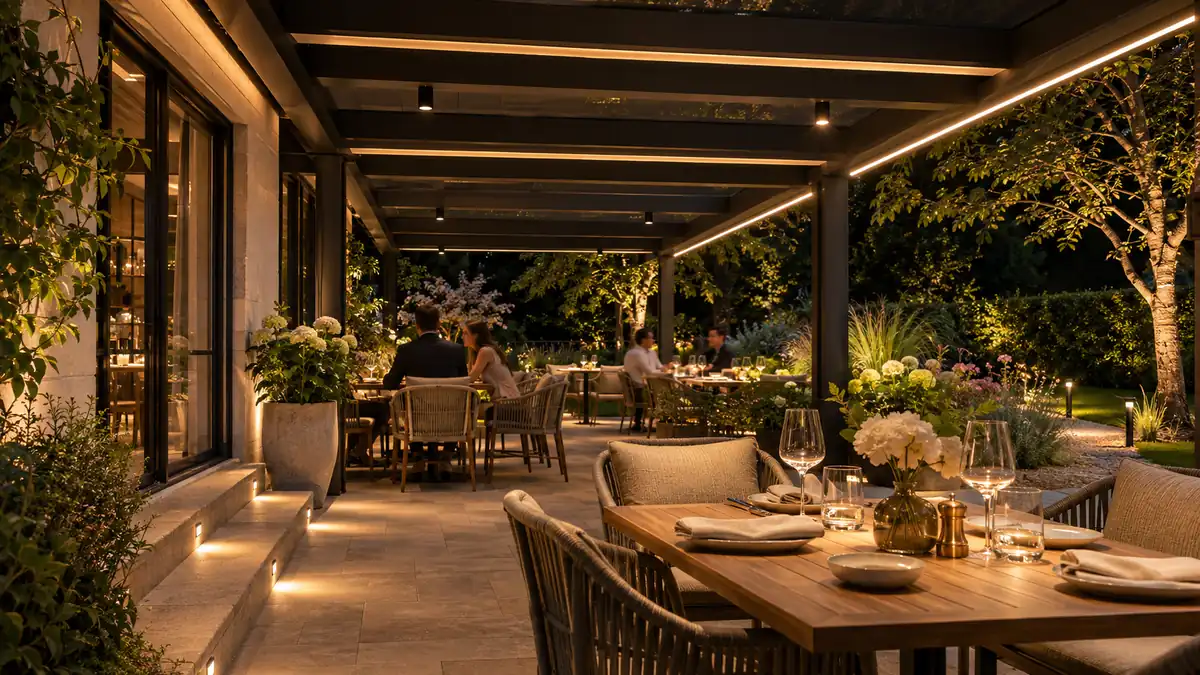
The same CCT should not be copied across every project type because the visual task changes. A residential patio supports faces and relaxation. A garden is viewed through layered foliage and darkness. A pergola combines structure, task surfaces, and concealed channels. Hospitality adds brand standards, longer operating hours, cleaning scenes, and replacement risk.
Patios and pergolas
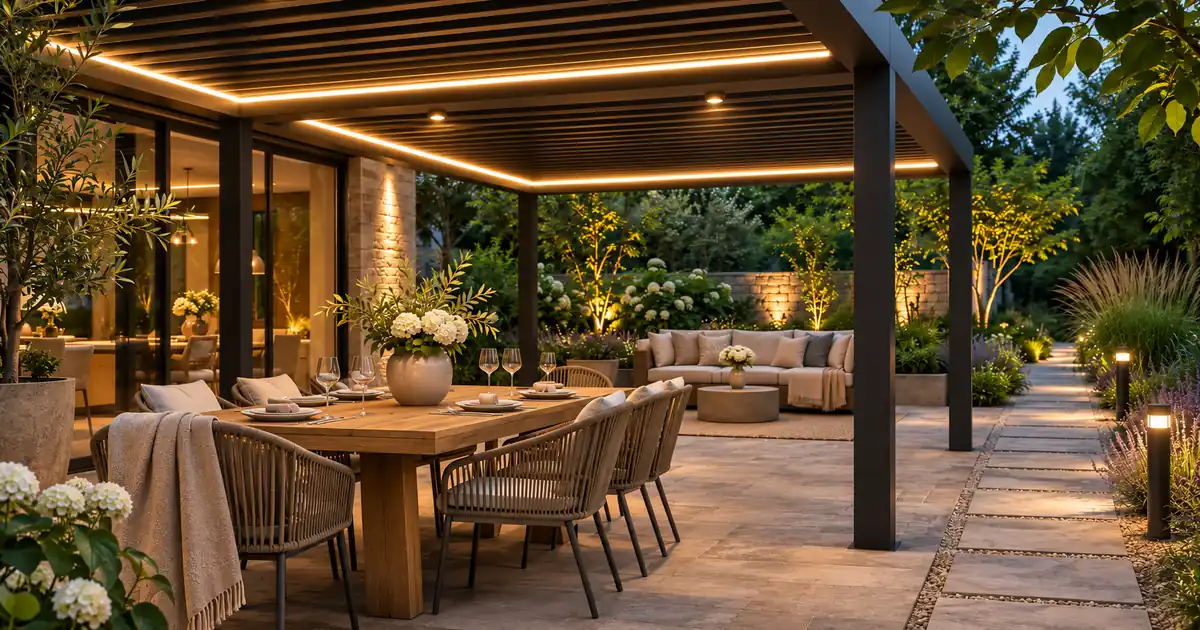
Start at 2700K for dining and seating. Move to 3000K when the structure is sharply contemporary, the finishes are pale, or the strip also supports practical circulation. Use linear light to reveal beams and edges, not to flood every surface. Pair it with controlled mini spotlights over tables or counters rather than driving the strip at excessive output.
A coordinated pergola, deck, and patio lighting kit can separate the structure, task, step, and landscape layers. This makes the CCT decision clearer because each layer has a defined role and control zone.
Gardens and landscape edges
Use 2200K to 2700K where the goal is a quiet, natural scene with restrained blue content. Use 3000K selectively when green foliage needs more neutral definition or when the garden belongs to a contemporary architectural composition. Keep luminance and spill low. A cool strip cannot rescue poor aiming or an exposed source.
Restaurants, hotels, and hospitality terraces
Begin with the guest experience, then add operational modes. A fixed 2700K scene can be excellent for dining. A tunable-white system may be justified when staff need a clearer setup or cleaning scene before returning to a warmer evening setting. The control interface must keep those modes simple enough for daily use.
Hospitality also raises the standard for color rendition. Food, skin, textiles, timber, tableware, and planting share the same view. The Illuminating Engineering Society’s TM-30 method measures fidelity, gamut, and hue-specific shifts, giving specifiers more useful information than one CRI number when the visual brand experience matters.
Why Can Two 3000K LED Strips Look Different?
Nominal CCT covers a permitted chromaticity region, not one exact point. The current ANSI C78.377 standard defines recommended chromaticity ranges for solid-state lighting. Two sources can carry the same 3000K label yet differ in tint, spectral distribution, color rendering, and visual match.
For visible continuous runs, define a color-tolerance target during sample approval. A three-step SDCM target or tighter is a practical starting point for premium, adjacent runs, but the complete assembly still needs visual comparison. Silicone extrusion, resin, diffuser material, LED operating temperature, and reflective surfaces can all shift the apparent result.
Nominal CCT
State the target value or tunable range, not “warm white.”
Chromaticity tolerance
Freeze the agreed bin or SDCM limit for samples and production.
Color rendition
Request CRI and R9, or TM-30 data when food, skin, textiles, or brand colors matter.
Assembly effect
Measure and view the strip through the production diffuser and waterproof construction.
Dimming behavior
Check flicker, minimum level, and color shift at the actual evening setting.
Batch continuity
Define how replacement stock will be matched to the approved production lot.
The Department of Energy’s LED lighting guidance describes CCT as a condensed measure that loses color information. It also notes that CRI does not fully predict saturated-red rendering. For a premium hospitality specification, review R9 or TM-30 data and perform a mock-up with representative food, fabrics, wood, stone, and planting.
Professional recommendation: do not approve CCT, CRI, diffuser, waterproof coating, and dimming as separate samples. Approve them as one production assembly.
Should You Choose Fixed White, Tunable White, or RGBW?
Choose fixed white when the project needs one repeatable atmosphere, tunable white when the same zone has genuinely different white-light jobs, and RGBW when colored scenes and useful white light must share one product. Each additional channel adds wiring, control, commissioning, documentation, and replacement complexity.
Fixed white keeps the product simple
A 2700K or 3000K fixed-white strip is usually the best commercial product when installers need predictable wiring and users mainly adjust brightness. It is easier to match, test, label, support, and replenish. For many residential pergolas and landscape ranges, good dimming creates enough scene variation without changing CCT.
Tunable white supports operational scenes
Tunable white is valuable when a restaurant terrace changes from setup to dinner to late-night service, or when one pergola product must suit several finish palettes. The U.S. Department of Energy’s tunable-white guidance explains that different LED-primary combinations can produce different chromaticity and rendering results even at the same nominal CCT. Test the full tuning path, not only the endpoints.
RGBW needs a real white-light specification
RGBW is the stronger choice when a hospitality, event, or premium outdoor-living product needs saturated color and usable white illumination. The dedicated white channel should have its own CCT, tolerance, color-rendering data, wattage, and dimming requirement. “RGBW” alone says nothing about the quality of the white scene.
For project-specific lengths, CCT ranges, RGBW configurations, connectors, and private-label packs, use a custom outdoor LED strip brief that locks the optical, electrical, mechanical, and packaging decisions together.
How Do You Write a Production-Ready CCT Specification?
Start with the scene and sightline, then freeze the measurable product requirements that preserve it. A quotation request that says “24V IP67 warm-white strip” is incomplete. It leaves the supplier to choose the actual CCT range, tolerance, color rendering, diffuser, connector, maximum run, dimming behavior, and batch-control method.
- Define each zone. Mark guest seating, dining, cooking, steps, structure, planting, service, and security. Record which zones remain visible together.
- State the scene intent. Describe whether the zone should feel intimate, neutral, architectural, task-focused, or late-night restrained.
- Set optical requirements. List nominal CCT, tolerance, CRI and R9 or TM-30 data, output, diffuser, dot visibility, and minimum dimming level.
- Set the electrical architecture. Confirm 12V or 24V, watts per metre, maximum tested run, feed method, driver, controller, cable gauge, and connector family.
- Define outdoor exposure. State whether the strip is sheltered, rain-exposed, subject to irrigation or pooling, coastal, buried, or submerged.
- Freeze traceability. Link the sample approval code to the LED bin, PCB, coating, diffuser, cable, connector, controller, label, and production lot.
The IEC 60529 IP Code classifies enclosure protection, but an IP number does not define UV resistance, heat management, drainage, cable-joint quality, or field sealing. Review the complete IP65, IP67, and IP68 strip-light application guide before treating the highest rating as the safest choice.
Finally, coordinate the strip with the rest of the product family. An OEM outdoor lighting kit BOM should freeze compatible fixtures, drivers, controls, connectors, extension cables, mounting parts, labels, manuals, and replacement SKUs. Visual consistency depends on interfaces as much as on LED selection.
How Should Buyers Approve LED Strip Samples Before Production?
Approve the system at night, at the intended dimmed level, and on representative materials. A strip viewed at full output on a white factory wall will not predict a restaurant terrace, timber pergola, stone planter, or wet landscape edge. Build the mock-up with production diffusers, waterproof construction, connectors, drivers, and controls.
Run a five-part approval
- Bench verification: confirm voltage, power, CCT, chromaticity tolerance, color-rendering data, cut interval, and control behavior.
- Material mock-up: view wood, stone, painted aluminum, fabric, food, foliage, and skin under the proposed strip and adjacent fixtures.
- Low-level test: dim to the real evening setting and check flicker, steps, color shift, channel balance, and controller recovery after power loss.
- Environmental review: inspect channel drainage, heat path, end seals, cable exits, connector access, UV exposure, and replacement method.
- Golden-sample control: sign and code the approved assembly, then compare pilot production and future replacement lots against it.
A professional supplier should be able to connect these approvals to production documents. VLED’s published capabilities cover mini LED spotlights, deck and step lights, COB strips, drivers, controls, accessories, kit development, and OEM/ODM customization. That range is useful when a pergola or landscape brand needs linear light, compact accent fixtures, and installation parts to share one visual and electrical strategy.
For a current product starting point, review the available single-color COB LED strip configurations. Then confirm the exact CCT, tolerance, CRI, voltage, waterproof construction, cut length, and certification scope for the intended market rather than assuming every listed option applies to one model.
Frequently Asked Questions
Is 2700K or 3000K better for an outdoor patio?
Choose 2700K when the priority is relaxed dining, flattering skin tones, timber, brick, or traditional architecture. Choose 3000K for a cleaner contemporary appearance, stronger definition on greenery, or a patio that also supports light task work. Test both at the intended dimmed level before approving production.
Should all outdoor LED strips use the same color temperature?
Use one dominant CCT family within each sightline, but do not force every functional zone to share one value. Guest-facing ambient and architectural layers can stay at 2200K to 3000K, while a screened food-preparation or service zone may use 3000K to 4000K. Separate controls and visual boundaries prevent a patchwork effect.
Is 4000K suitable for garden or hospitality lighting?
4000K can work for focused preparation, maintenance, back-of-house, or security tasks. It is rarely the best continuous setting for dining terraces, pergolas, lounges, or planted gardens because it can make the scene feel harder and more commercial. Keep it shielded, separately controlled, and outside the primary guest sightline.
Does high CRI remove the need to choose the right CCT?
No. CCT describes the apparent warmth or coolness of white light, while color-rendering metrics describe how that light changes the appearance of objects. A project needs both. For hospitality, food, skin, planting, and premium materials, request CRI data and, when available, TM-30 data, then verify the result in a mock-up.
When is tunable-white LED strip worth the added complexity?
Tunable white is worthwhile when one space must support visibly different operating modes, when seasonal finishes change, or when a hospitality operator needs separate setup, dining, late-night, and cleaning scenes. It is unnecessary when users need one stable atmosphere and simple dimming can deliver the required variation.
The Better Rule: Specify the Night Scene, Then Specify the Strip
Outdoor LED strip color temperature should follow the experience a space must deliver and the conditions the product must survive. Start with 2700K for warm guest-facing scenes and 3000K for cleaner mixed-use projects. Move outside that range only when the zone, operating mode, or environmental goal provides a clear reason.
Then go beyond Kelvin. Freeze color tolerance, rendering, dimming, diffuser, waterproof construction, control logic, batch consistency, and replacement access. That is how a pleasing sample becomes a repeatable product instead of a one-night demonstration.
Build a CCT Specification That Can Survive Production
Share the project type, zone plan, materials, target CCT, required lengths, voltage, controls, outdoor exposure, target market, and estimated volume. The technical team can review the strip, matching mini spotlights or deck lights, connectors, driver, packaging, and sample-approval plan as one system.
Send Us Your Request