






The strongest outdoor LED lighting kits for compact gardens, courtyards, and rooftop terraces are modular. They combine a low-voltage control layer, discreet mini spotlights for focal points, deck or step lights for movement, and concealed linear light for architectural edges. This approach gives landscape brands and project suppliers a repeatable system that can be adapted to different layouts without making every installation look like the same product package.
A small space magnifies lighting mistakes. A single exposed bright source can dominate a courtyard. Too many downlights can flatten planting and make a rooftop terrace feel like a commercial corridor. On the other hand, a few carefully aimed sources can reveal wall texture, give a tree visual weight, define a step, and make a pergola feel like an outdoor room.
For buyers and specifiers, the design question is therefore not “How many lights fit here?” It is “Which lighting jobs must the kit perform, and which fixture should perform each job?” The following ideas use that question as the starting point.
1. Build the kit around three lighting jobs
A compact outdoor lighting system usually needs three layers: ambient light for orientation, task light for activities, and accent light for depth. They can share a power architecture, but they should not be forced to behave identically.
Ambient
Soft background light from concealed strips, wall washes, or carefully spaced overhead fixtures. It prevents the space from disappearing beyond the seating area.
Task
Focused light at steps, dining surfaces, outdoor kitchens, bars, and circulation points. It should support an activity without shining into people’s eyes.
Narrow or adjustable light on planting, textured walls, posts, planters, water, or a selected architectural detail. This is the layer that creates depth.
This layered approach is consistent with the Five Principles for Responsible Outdoor Lighting published by DarkSky International and the Illuminating Engineering Society: use light only when needed, target it carefully, keep levels low, control it, and prefer warmer colour where possible.
2. Use mini spotlights to create depth in a small garden
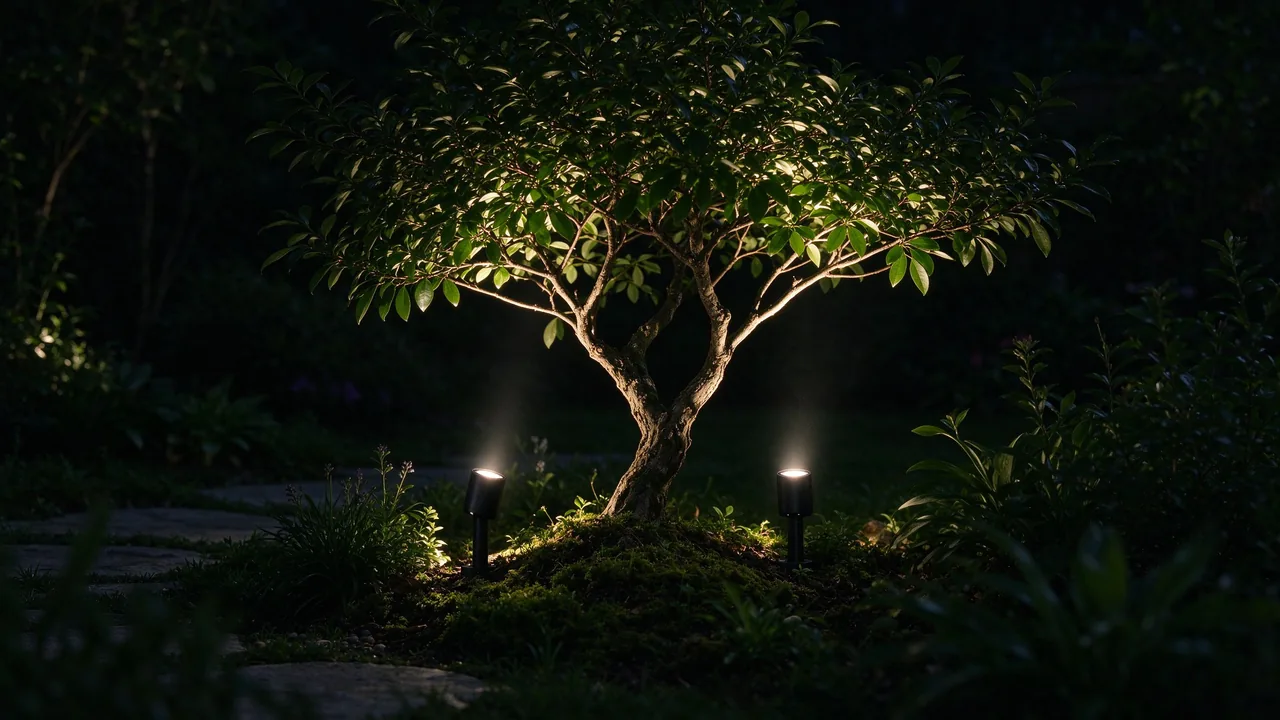
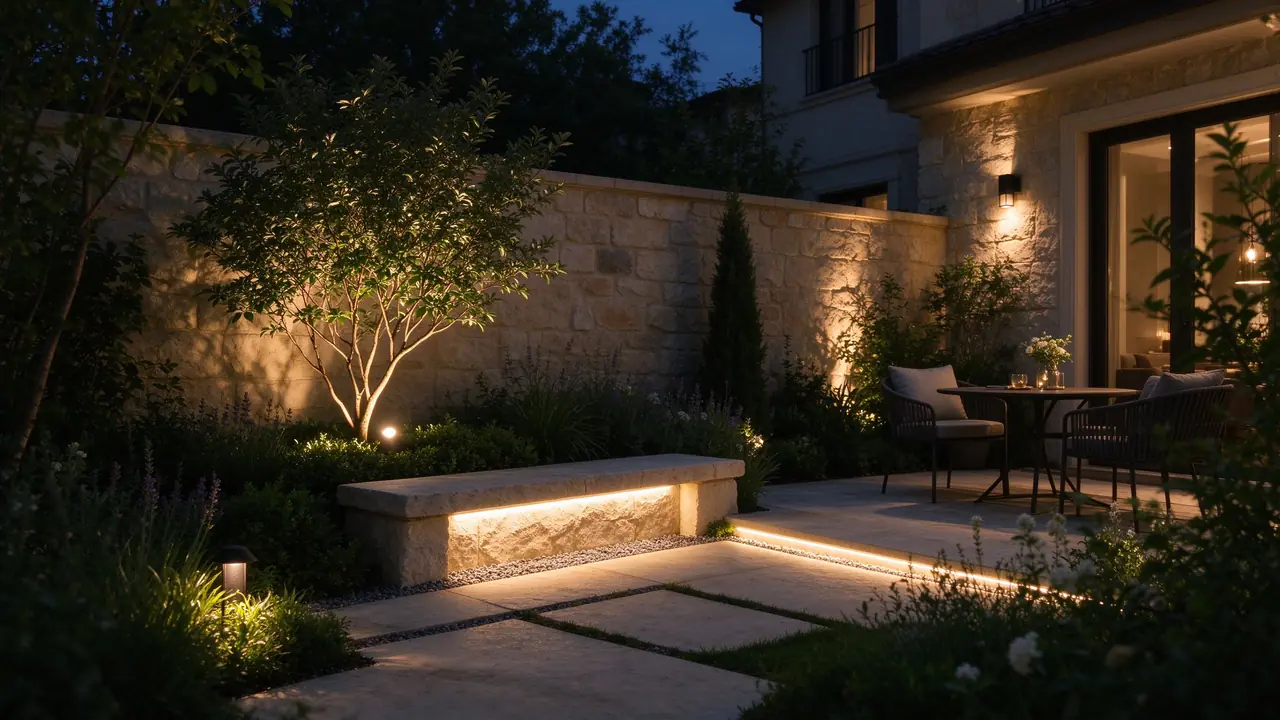
In a small garden, the most effective mini LED spotlight ideas are usually vertical. Aim one or two fixtures into the canopy of a compact tree, graze a textured boundary wall, or pick out a large planter at the far end of the view. Lighting the background gives the eye somewhere to travel and makes the garden feel deeper after dark.
Idea: one focal tree, two lighting moods
Use an adjustable or narrow-beam mini spotlight at the base of a tree or sculptural plant for a calm evening scene. A second fixture can be aimed across the trunk or foliage rather than straight upward, creating shadow and texture. Put the two fixtures on a dimmable circuit so the planting can shift from a stronger arrival scene to a low-level entertaining scene.
For a manufacturer or distributor, this is a useful kit logic: the customer does not need a large floodlight. They need a small number of consistent fixtures with predictable beam options, finishes, cable lengths, connectors, and control compatibility. VLED’s mini LED spotlight range is designed around this type of flexible application, with outdoor models offering options such as 12V or 24V DC, dimming, multiple CCT choices, RGB or RGBW configurations, and IP65-rated construction on selected products.
Do not specify every feature for every project. A quiet residential courtyard may need warm white dimming and a discreet black or dark finish. A hospitality terrace may benefit from dynamic white or RGBW, but only if the control system makes those modes simple for staff to use. A good kit keeps the upgrade path open without making the base installation unnecessarily complicated.
3. Make courtyard walls do the work
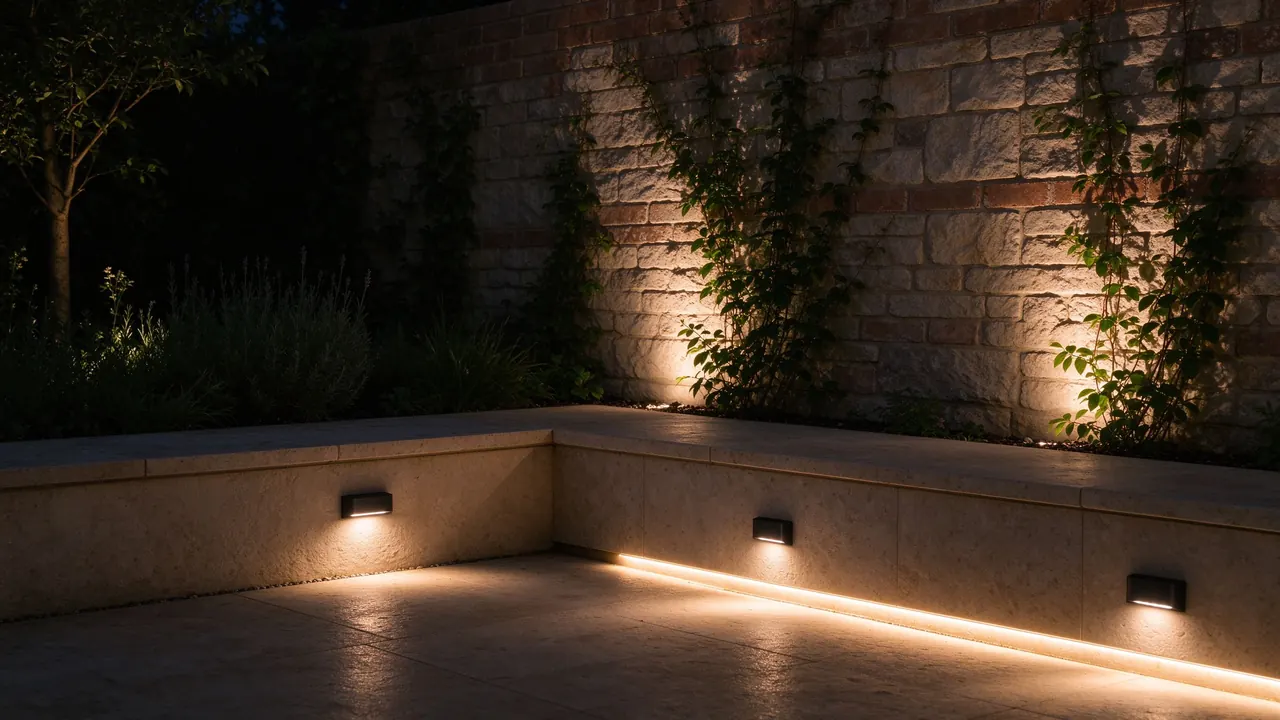
Courtyards have a natural advantage: walls reflect and frame light. The best courtyard lighting ideas often use the vertical boundary as a large, low-brightness surface rather than filling the floor with fixtures.
Idea: wall grazing behind planting
Place compact spotlights low and close to a textured wall, planter, or climbing plant. Test the distance before fixing the lights permanently: moving a fixture only a small amount can change a soft wash into a hard hotspot. The aim is not to make the wall bright; it is to reveal its texture and create a background layer behind furniture.
Idea: concealed light under a ledge or bench
A short run of concealed COB LED strip can provide a continuous visual line beneath a bench, planter edge, coping, or wall cap. It is especially useful where a row of visible points would make a compact courtyard look busy. VLED’s COB LED strip range includes 12V and 24V options, narrow PCB formats, high-density LED layouts, and cuttable configurations that can be planned around project dimensions.
Use an aluminium profile and a suitable diffuser where the strip is exposed to view or needs protection. The profile is not just a finishing detail: it supports heat management, keeps the light line straight, and helps prevent the individual LED image from becoming the visual feature.
4. Treat steps and thresholds as a separate safety layer
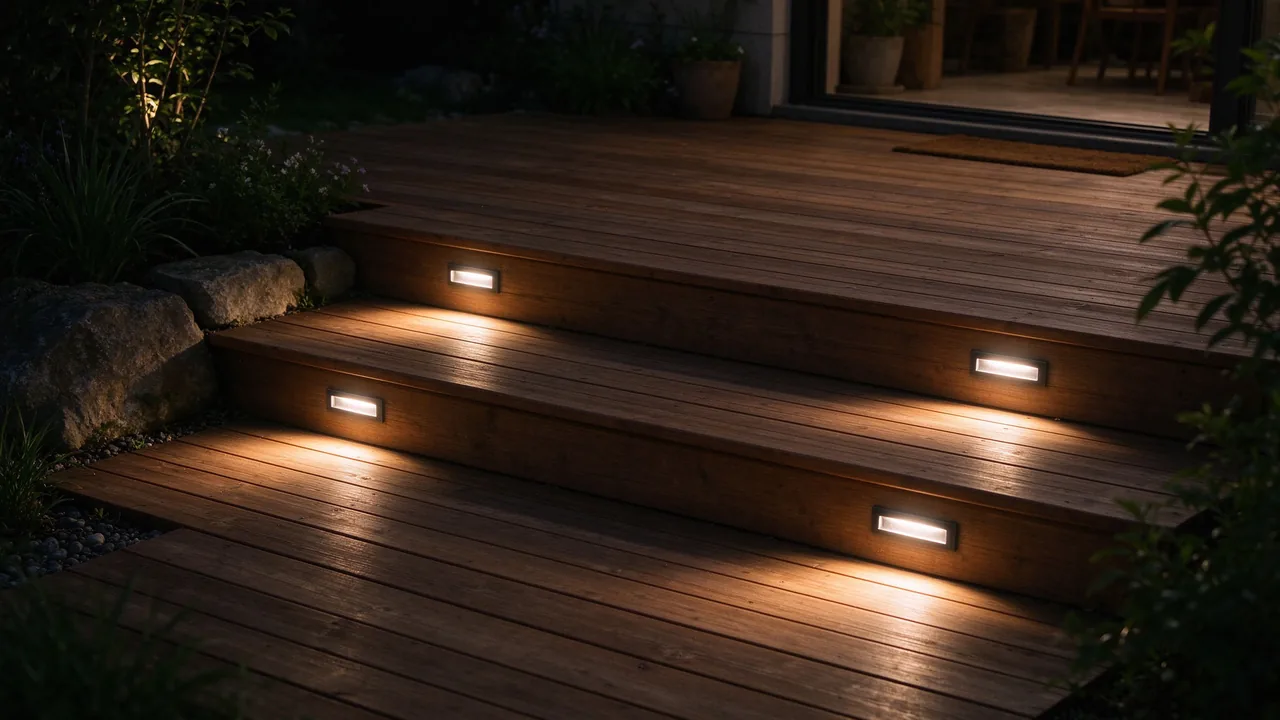
Small gardens and rooftops often contain one or two level changes that are easy to overlook in daylight. A lighting kit should identify these thresholds early and give them a dedicated, low-glare solution.
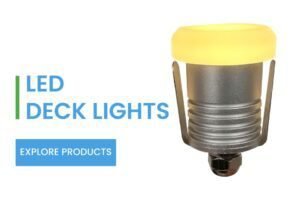
Recessed deck or step lights can mark the edge of a stair, raised planter, deck transition, or narrow path without placing a tall object in the walking line. VLED’s LED deck light collection includes recessed 12V and 24V DC products with IP65-rated options, dimming, multiple CCT and colour configurations, and compact cutout formats. The exact fixture should still be selected against the paving, drainage, structural depth, cable route, and local electrical requirements.
For a project kit, separate step-light circuits from decorative planting lights. When the customer wants a late-night low setting, the route can remain readable while the accent layer fades down. This is more useful than putting every fixture on one switch and asking the user to choose between a dark path and an overlit garden.
5. Design a rooftop terrace as a sequence of zones
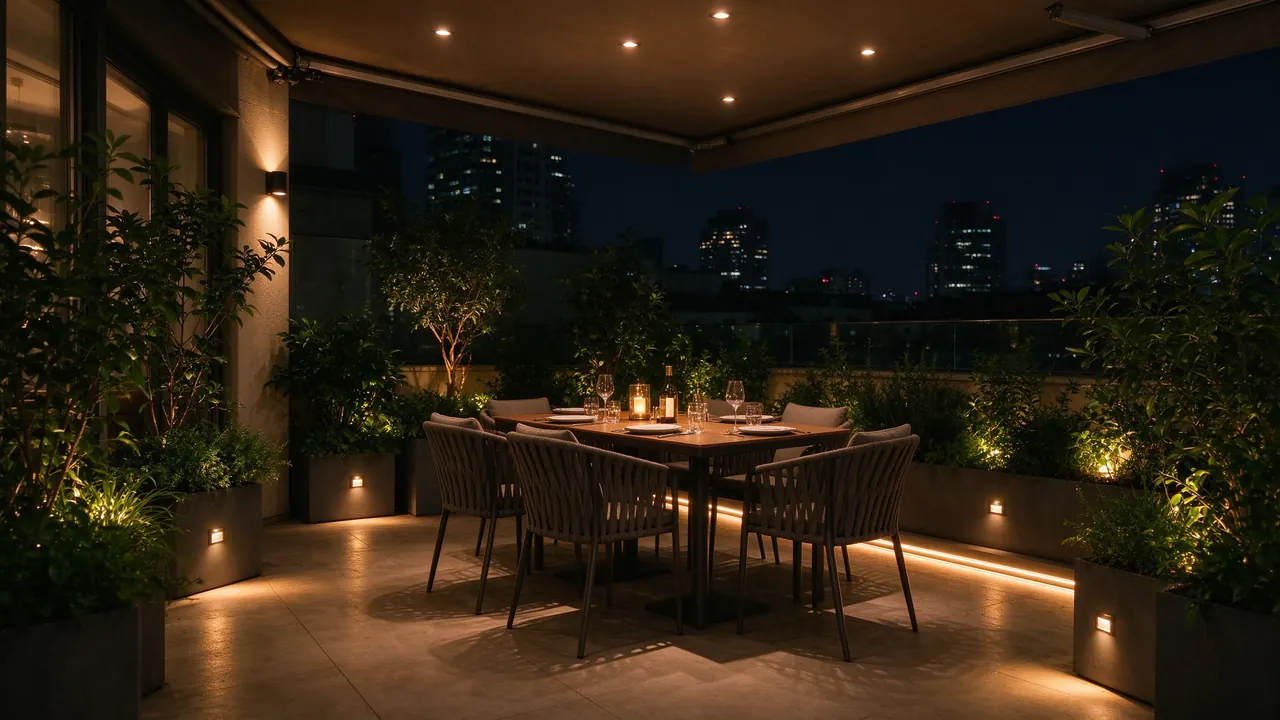
A rooftop terrace may be physically small, but it usually contains several different uses: arrival, seating, dining, planting, circulation, and sometimes an outdoor kitchen or bar. Lighting should follow those uses instead of treating the roof as one open rectangle.
| Terrace zone | Useful lighting kit element | Specification priority |
|---|---|---|
| Entry and threshold | Low-level step or deck lights | Glare control, robust installation, clear edge definition |
| Dining surface | Focused downlight or concealed linear light | Comfortable light on the table, dimming, colour quality |
| Seating area | Soft ambient layer plus one or two accents | Warm appearance, no direct view of bright sources |
| Planters and green wall | Mini spotlights or hidden strip | Beam control, adjustable aiming, maintenance access |
| Perimeter and parapet | Very restrained indirect or reflected light | Light trespass, wind exposure, neighbours’ sightlines |
Rooftop projects also need a more disciplined approach to cable routing, waterproofing, wind, drainage, and maintenance access. A fixture that works beautifully in a sheltered courtyard may not be appropriate on an exposed roof. Specify the complete system—fixture, cable, connector, driver, junction protection, control, and installation detail—rather than evaluating the lamp in isolation.
6. Use pergola lighting as a ceiling, not a ceiling full of dots
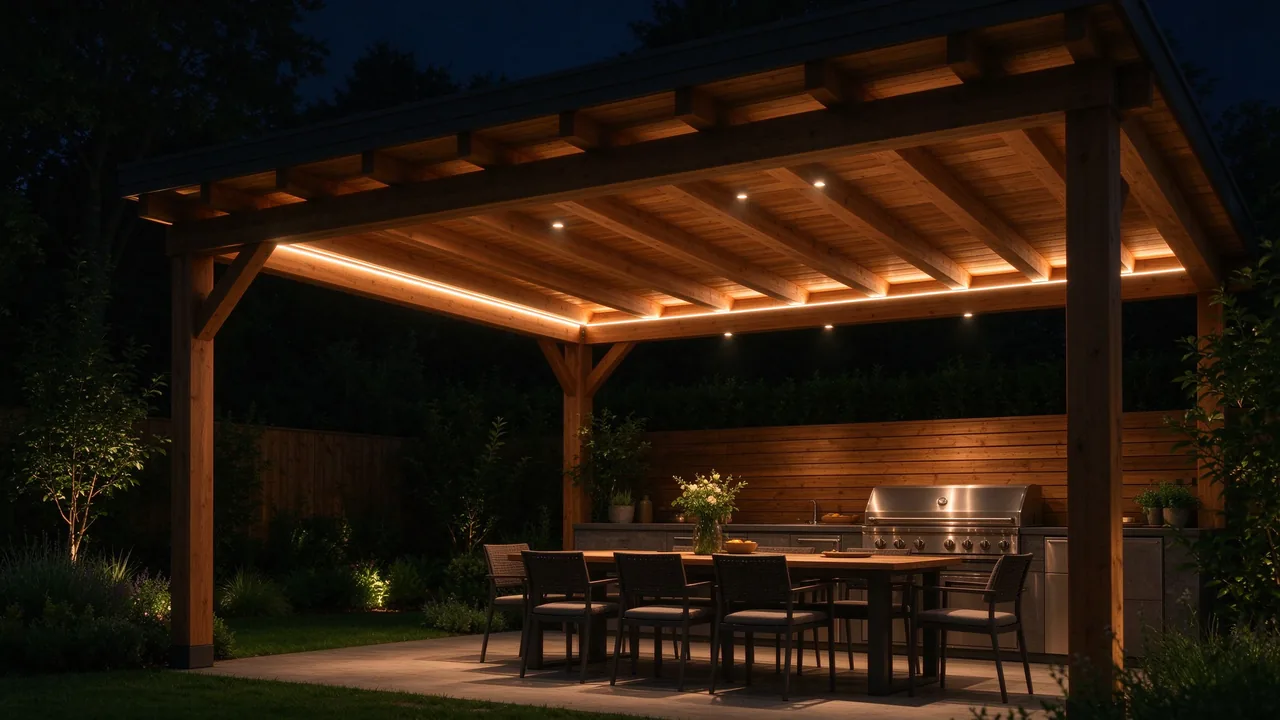
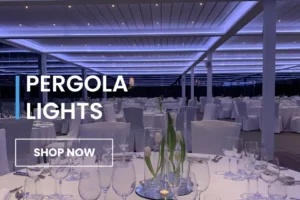
A pergola is often the main architectural element in a compact garden or terrace. The lighting should reinforce its structure: beams, louvers, posts, and the table below. Too many visible downlights make the roof pattern noisy. Too much strip light can create a bright outline with no useful light at the centre.
Idea: combine a soft perimeter with selective downlights
Use concealed strip light under a beam or along a selected perimeter to create a gentle ceiling glow. Add only the number of mini spotlights needed for dining, food preparation, or a bar. Keep those task lights dimmable and aim them at the working plane, not at seated eye level.
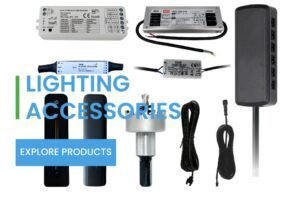
For pergola brands and their lighting suppliers, a kit is easier to sell and install when it is built around repeatable harnesses, labelled cable branches, preselected driver capacity, and clear control scenes. VLED’s mini LED light kit y pergola lighting and control platform show how spotlights, strips, deck lights, and RF or smart control can be developed as a system rather than as unrelated parts.
7. Choose specifications by application, not by feature count
Professional buyers should compare outdoor LED kits through a short specification checklist. More functions do not automatically mean a better result; compatibility and repeatability matter more.
VLED product pages list examples of these variables, including 3W CREE/Epistar/Sanan LED options, 2700–6500K or RGBW configurations, beam angles from narrow to wide, recessed or fixed mounting, and IP65-rated outdoor models. Treat these as a starting point for a project conversation, then confirm the final configuration in the quotation and technical datasheet.
The U.S. Department of Energy’s LED basics guide also makes an important distinction between source efficacy and luminaire efficacy. For a commercial or project buyer, the practical lesson is simple: compare the complete fixture and system performance, not just the LED chip or a marketing lumen figure.
8. Make controls part of the lighting concept
Controls are what allow a small outdoor space to serve more than one purpose. A terrace may need bright enough task lighting while food is being prepared, a relaxed warm scene during dinner, and a low-level pathway setting after guests leave.
At minimum, separate the system into ambient, task, and accent groups. Where the product architecture supports it, add dimming, scheduling, remote control, or app control. Keep scene names understandable to the end user. “Dinner,” “Late evening,” and “Cleaning” are more useful than a list of technical channel numbers.
Responsible controls also reduce unnecessary light. DarkSky’s guidance recommends using light only when it is needed and controlling it through dimming, timers, or sensors. In a rooftop or courtyard project, this is both an environmental decision and a practical way to reduce glare for neighbours and occupants.
9. The kit formats that work best for professional buyers
For landscape lighting brands, pergola manufacturers, import wholesalers, and engineering contractors, three kit formats are particularly useful.
Starter kit for a compact garden
Include a small number of mini spotlights for one tree, wall, or planter, a separate low-level path or step option, a driver, cable, connectors, and dimmable control. This kit is easy to demonstrate and can be expanded without changing the visual language.
Courtyard architectural kit
Combine wall-grazing spotlights, a concealed COB strip section, and one low-level threshold circuit. This format suits courtyard renovations, hospitality courtyards, and compact urban gardens where the walls are part of the design.
Pergola and rooftop terrace kit
Combine beam or louver lighting, selective downlights, deck or step lights, and multi-scene control. Offer options for different roof sizes, cable exits, finishes, and control platforms. The value for the buyer is not simply the light count; it is reduced design time and a more predictable installation.
VLED has focused since 2010 on designing and manufacturing small LED spotlights, mini downlights, and LED kits, and describes its business as an OEM/ODM and NDA partner for global lighting brands. Its company and R&D page provides further background on the design and manufacturing capability. For custom product development, finish changes, kit assembly, or project-specific control requirements, use the VLED contact page to discuss the application before selecting a fixed bill of materials.
Common mistakes to avoid in small outdoor spaces
Over-lighting the entire floor. A bright floor removes contrast and makes the space feel smaller. Light selected surfaces and paths instead.
Using one colour temperature everywhere. Consistency matters, but different functions may need different scenes. Keep the base palette coherent and use colour-changing modes selectively.
Placing fixtures where maintenance is impossible. Leave access to drivers, connectors, profiles, and drainage points. A hidden fixture is only successful if it can still be serviced.
Specifying IP rating without checking the installation. Confirm the full assembly and local requirements. Water can enter through poor cable joints, unprotected connections, or incorrect mounting even when the lamp body has a suitable rating.
Letting the control system become the product. Homeowners, hospitality staff, and installers need reliable scenes and clear commissioning. Fancy features that are difficult to operate reduce the value of the whole kit.
Frequently asked questions
What is the best type of LED lighting for a small garden?
A layered combination usually performs best: mini spotlights for trees and walls, low-level deck or step lights for movement, and concealed strip light for architectural edges. The exact mix depends on the garden’s planting, wall surfaces, activity zones, power layout, and exposure.
Are mini LED spotlights suitable for outdoor pergolas?
Selected outdoor mini spotlights are suitable for pergolas when their IP rating, voltage, mounting method, cable routing, and control system match the installation. Always check the individual product specification. Indoor-rated IP20 products should not be treated as exposed outdoor fixtures.
Should a courtyard use warm white or RGBW lighting?
Warm white is usually the stronger default for everyday courtyard ambience, planting, and hospitality seating. RGBW or dynamic white can be valuable where the project needs programmed scenes, seasonal colour, or brand-led experiences, but it should remain controllable and easy to return to a comfortable white setting.
How many lights does a rooftop terrace need?
There is no useful universal count. Start by mapping the entry, steps, dining surface, seating, planting, and perimeter. Then assign each lighting job to the smallest number of fixtures that delivers safe movement, comfortable task visibility, and visual depth without glare.
Final recommendation for brands and project suppliers
The most commercially useful outdoor LED lighting kit is not the one with the longest feature list. It is the one that can be specified quickly, installed cleanly, controlled intuitively, and adapted across several small-space layouts.
Start with three layers. Use mini spotlights to reveal depth, deck or step lights to clarify movement, and concealed strip light to connect the architecture. Keep the circuits separate, select the IP rating for the real exposure, and make dimming and controls part of the design from the beginning.
Build a small-space lighting kit around your product line
If you are developing a pergola lighting package, adding landscape fixtures to a product range, or sourcing an OEM/ODM mini LED spotlight system, VLED can help you review the application, fixture format, voltage, optics, finish, kit structure, and control requirements.
Contact VLED for a project discussion or explore the full mini LED spotlight and lighting kit range.
Send Us Your Request