






The bottom line
- 12V is usually the easier choice when compatibility, retrofit flexibility, and small branch circuits matter most.
- 24V is usually the stronger choice for longer cable runs, higher total loads, and repeatable commercial or pergola systems.
- At the same wattage, a 24V fixture draws half the current of a 12V fixture, but voltage alone does not make a light brighter.
- The right specification is the one that keeps every fixture within its rated input range after cable loss, not the one with the higher number.
Many buyers still ask the question as if 24V were a performance upgrade over 12V. That framing causes avoidable problems. A well-designed 12V deck light can deliver the same optical result as a 24V model when the LED package, driver, lens, thermal path, and operating current are properly matched.
The real difference appears in the distribution system. This guide explains where each voltage earns its place, how to compare a project honestly, and which details should be written into a product specification before purchasing or private-label production.
12V vs 24V LED deck lights: what is the practical difference?
At equal power, 24V halves circuit current because electrical power is calculated as voltage multiplied by current. That reduces resistive cable loss and gives a 24V branch more headroom on long runs. It does not automatically increase lumen output, beam quality, service life, or IP protection.
| Project factor | 12V system | 24V system |
|---|---|---|
| Current at the same wattage | Higher current | About half the current |
| Voltage-drop sensitivity | Higher at the same load and cable length | Lower at the same load and cable length |
| Existing-system compatibility | Often easier for residential retrofits | Requires compatible drivers, controls, and fixtures |
| Best fit | Small zones, short runs, mixed replacement stock | Longer runs, larger zones, standardized new systems |
| Key risk | Dimming or color inconsistency at the far end of a branch | Connecting 12V components to a 24V source |
For U.S. projects, low-voltage lighting requirements still depend on the complete system, including the isolating power supply, luminaires, and associated equipment. The NEC material published by NFPA describes low-voltage lighting limits and power-supply requirements in Article 411, so the final installation should be checked against the local code and the authority having jurisdiction.
When should you choose 12V LED deck lights?
Choose 12V when the project values broad compatibility more than maximum distribution efficiency. This is common in residential decks, small patios, replacement work, and product ranges that need to coexist with an installed base of 12V transformers, connectors, and landscape fixtures.
12V is useful for retrofit and mixed-product work
A contractor replacing a few stair or deck fittings may not want to rebuild the whole low-voltage system. If the existing transformer and controls are suitable, a 12V product can reduce the number of new components and simplify service. This matters to wholesalers too: a familiar voltage can make training, stock rotation, and installer support easier.
12V supports fine-grained small-zone planning
Short runs with a modest number of 1W to 3W fixtures can perform very well at 12V. Recessed deck lights, step lights, cabinet spots, and small pergola accents often fall into this category. The important qualification is that the cable plan must be sized for the load and distance. A short branch is not automatically a safe branch if too many fixtures are concentrated at the end.
12V is also a sensible option when a project needs a broad range of compatible replacement products. It becomes less attractive when the design has several branches, long perimeter runs, or a high fixture count and the installer is already planning a new power architecture.
When does 24V make more sense for a deck, patio, or pergola project?
Choose 24V when the project has longer distribution paths, higher aggregate wattage, or a need for repeatable system design across multiple installations. Because the same power requires less current, 24V can reduce voltage drop and conductor loss, subject to the actual cable size, topology, load, and driver design.
Longer runs are a system-design issue, not a fixed distance rule
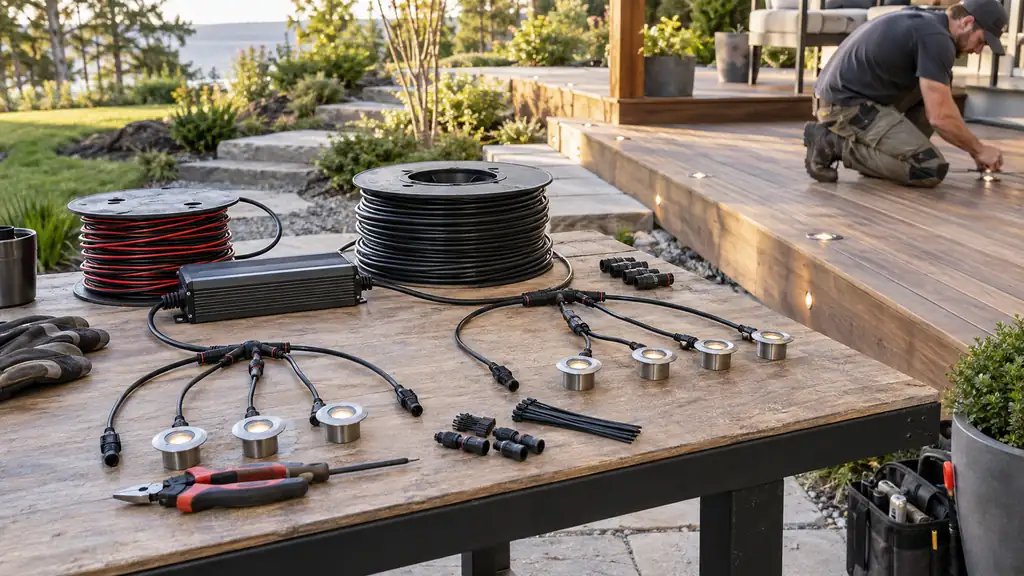
There is no honest universal rule that says 24V becomes necessary at one exact distance. A 30-foot run with a large load may be more demanding than a 100-foot run with a few small lights. Calculate the branch current, account for the round-trip conductor length, and verify the voltage at the farthest fixture.
Useful starting point: current in amps = total watts divided by system voltage. A 60W branch is approximately 5A at 12V and 2.5A at 24V, before considering driver losses and design margin.
Use a professional voltage-drop tool such as Southwire’s Voltage Drop Calculator to test the actual cable size, distance, load, voltage, and permitted drop. The result should be treated as a design check, not a substitute for local electrical requirements or the manufacturer’s installation instructions.
24V helps standardize larger product families
For a pergola supplier or landscape brand, 24V can make it easier to build a repeatable kit architecture. The same driver family may support more fixtures before current capacity becomes the limiting factor. That can simplify BOM planning, control selection, and installation documentation across several deck or outdoor living packages.
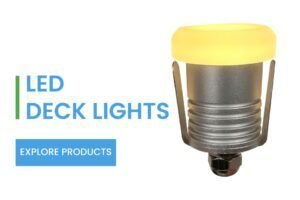
VLED’s SLED deck light platform is a useful example of a specification that supports this kind of project discussion. The listed fixture is a 3W recessed deck light with DC12V/DC24V input options, IP65 protection, dimming, multiple white and color configurations, and a compact cutout. For a brand or project buyer, the value is not simply the voltage choice. It is the ability to align the fixture, driver, dimmer, connectors, and installation method as one tested package.
Does 24V make LED deck lights brighter?
No. Voltage is an electrical input condition, not a brightness rating. Light output depends on LED efficacy, drive current, optical design, lens transmission, thermal management, color temperature, and the delivered voltage at the fixture.
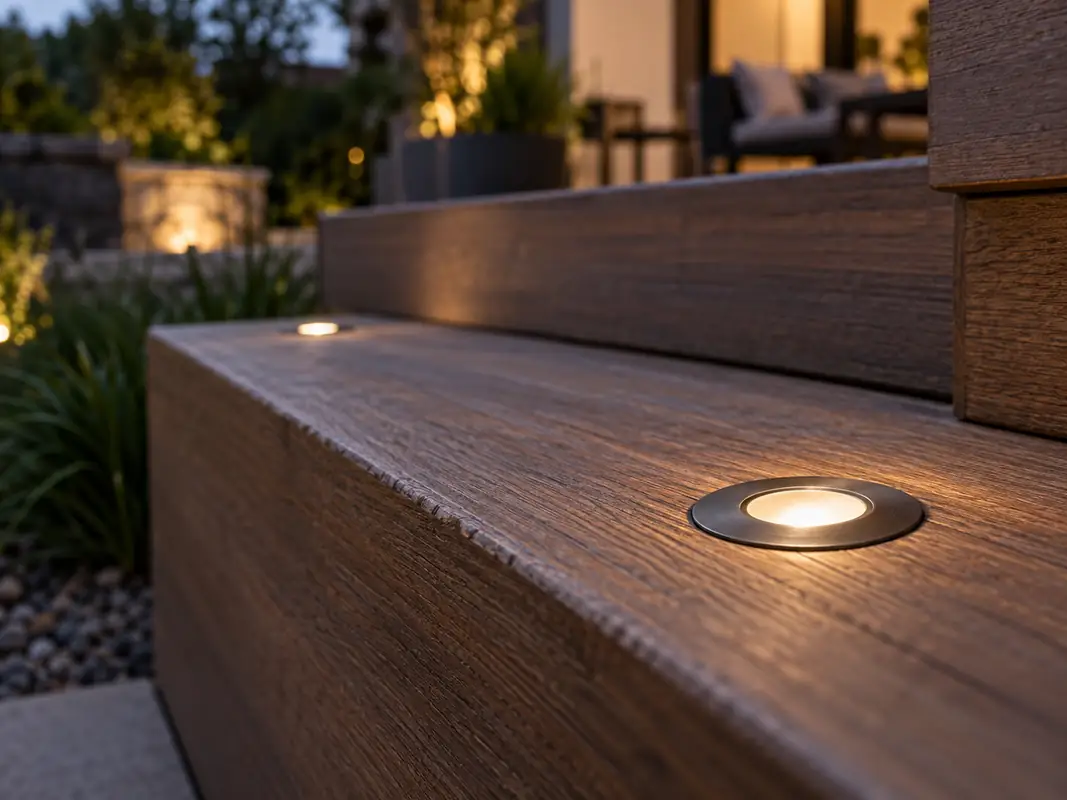
The U.S. Department of Energy explains that LED performance should be considered through both source efficacy and luminaire efficacy, meaning how effectively the complete fixture turns electrical input into useful light. That is why two products with the same nominal voltage can look very different on a deck or stair project. Compare tested lumens, beam distribution, glare control, CRI, color consistency, and dimming behavior instead of using 12V or 24V as a shortcut for brightness.
For outdoor deck lighting, optical comfort is often more important than raw output. A small recessed fixture with controlled diffusion can create a safer and more premium result than a brighter product that produces hot spots or glare at eye level.
How do wiring, drivers, and controls change the decision?
The fixture voltage, driver output, dimming method, connector system, and control protocol must be specified together. A 12V or 24V label on one component cannot validate the rest of the circuit.
Match AC and DC ratings exactly
Do not assume that a 12VDC fixture can run from a 12VAC transformer, or that a 24VDC fixture can connect to a 24VAC source. Some products accept a defined range, but that range must appear in the technical data. A 12V fixture connected directly to a 24V supply can fail immediately or suffer shortened life.
Check the control method before approving the sample
On-off switching, PWM dimming, constant-current drivers, RGBW controls, smart app systems, and RF remotes are not interchangeable. For a commercial or private-label kit, test the complete chain at minimum and maximum load. Check start-up, low-level dimming, color consistency, cable connectors, and behavior after a power cycle.
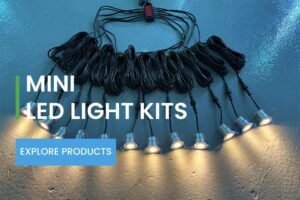
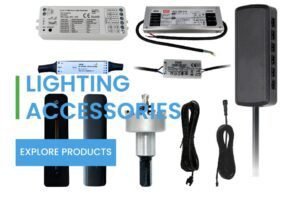
VLED’s mini LED light kits e lighting accessories show why the kit architecture matters. Drivers, power supplies, splitters, extension cables, and installation tools are part of the field result. A fixture-only quotation can look competitive while leaving the buyer to solve the system risk later.
Which voltage is better for wholesalers and lighting brands?
For wholesalers and brands, the better voltage is the one that produces a clear, repeatable offer for the market you serve. 12V often reduces adoption friction in replacement and residential channels. 24V often creates a cleaner platform for new-build pergola, patio, and landscape packages with defined cable routes and centralized controls.
| Buyer situation | More likely fit | Why |
|---|---|---|
| Replacement stock for mixed residential systems | 12V | More likely to match existing infrastructure |
| New pergola package with multiple zones | 24V | Lower current and easier repeatability on planned branches |
| Small deck or stair retrofit | 12V or dual-voltage | Short runs and compatibility may outweigh distribution gains |
| Large patio perimeter with smart control | 24V | More electrical headroom, if drivers and controls are designed for it |
| One product family for several markets | Depends on market | Use regional transformer, code, connector, and stock requirements to decide |
A manufacturer with in-house R&D and production can make this decision more useful by validating both electrical variants against the same mechanical and optical platform. VLED has focused on small LED spotlights, mini downlights, LED kits, and outdoor deck lighting since 2010, with OEM/ODM development and customized samples for global lighting partners. For a product brand, that kind of engineering support can be more valuable than choosing a voltage based on a generic market slogan.
What should be in a professional 12V or 24V deck light specification?
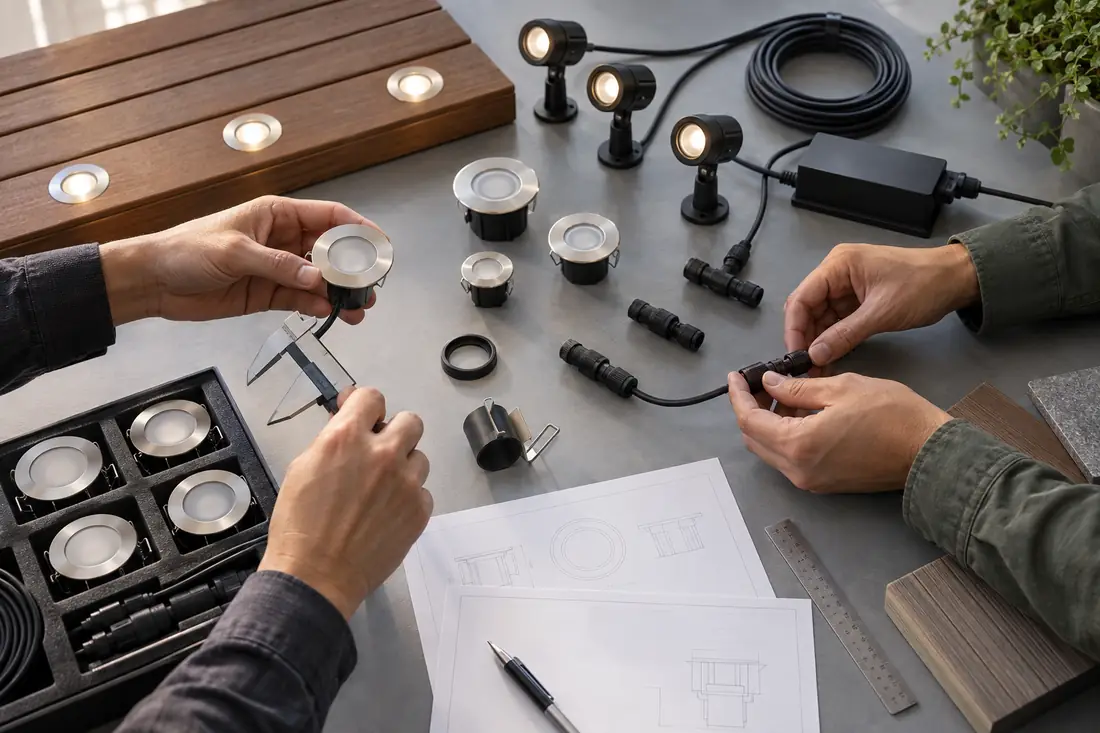
A procurement-ready specification should allow an installer to design the circuit and allow a buyer to compare suppliers without hidden assumptions. At minimum, request the following data for the fixture and the complete kit.
- Input voltage and current type: AC, DC, or an explicitly stated input range.
- Rated wattage, start-up behavior, power tolerance, and recommended system margin.
- Delivered lumens, efficacy, CCT options, CRI, SDCM, beam or diffusion details, and optical test data.
- IP rating, housing material, lens material, operating temperature, and installation depth.
- Dimming method, controller compatibility, minimum dimming level, and maximum connected load.
- Driver, power supply, splitter, connector, cable, and extension specifications.
- Cutout dimensions, mounting method, warranty terms, packaging, and replacement availability.
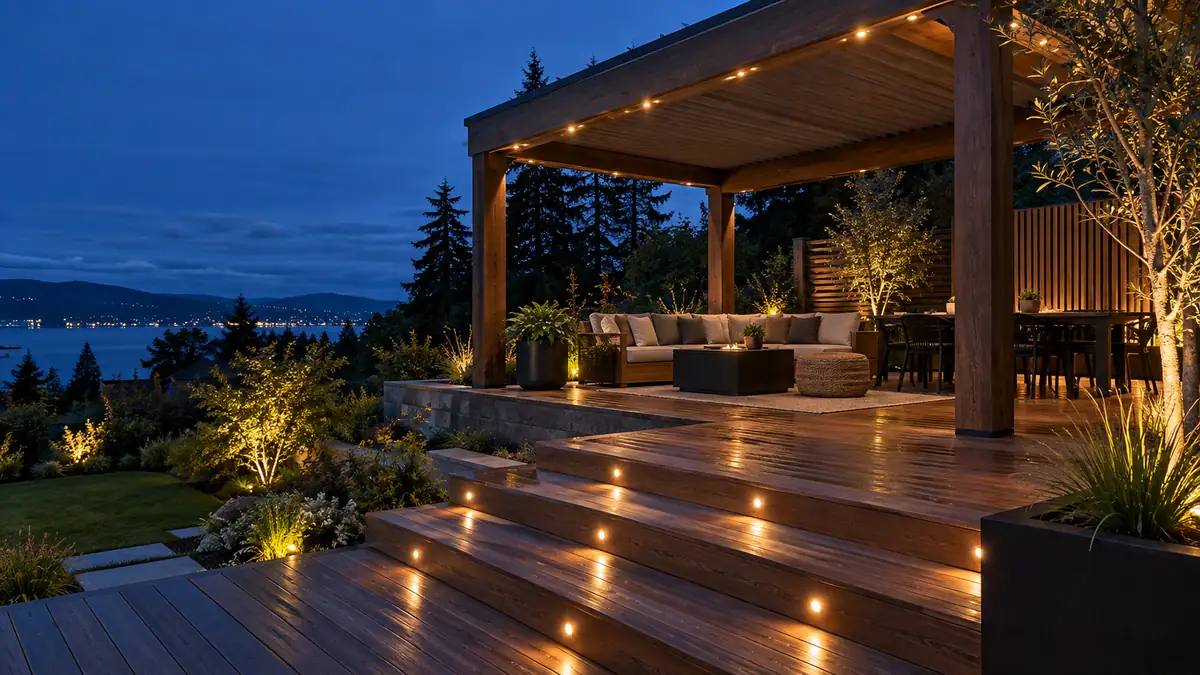
For outdoor products, do not treat IP65 as a complete installation guarantee. The cable entry, connector, splice, drainage, recess design, and surrounding construction all affect real-world water exposure. The product page for VLED’s LED deck light range lists common project applications such as decks, patios, paths, stairs, pergolas, and landscapes, but the final installation still needs a project-specific wiring and drainage plan.
Frequently asked questions
Can 12V and 24V LED deck lights be used on the same circuit?
Only when the system includes the correct conversion or separate rated outputs. A 12V fixture should not be connected directly to a 24V source. Confirm the input range printed on the fixture, driver, controller, and power supply before combining products.
Are 24V LED deck lights more energy efficient than 12V lights?
The LED itself is not automatically more efficient because it is 24V. The system can have lower cable losses because the same wattage draws less current. Actual efficiency still depends on the driver, fixture efficacy, cable length, load balance, and control method.
Is 24V always better for pergola lighting?
No. 24V is often a strong starting point for a new pergola package with multiple fixtures and planned cable routes, but 12V may be the better commercial choice when the project must match an existing landscape system. Test both the electrical design and the local supply chain before standardizing a product family.
Our recommendation: select the system before selecting the fixture
For most small residential retrofit jobs, start with 12V if the existing infrastructure is compatible and the voltage-drop calculation passes. For planned pergola packages, larger deck areas, and repeatable landscape systems, start with 24V when the controls, driver, cabling, and fixtures are all designed as one platform.
Then test the decision against four questions: How many watts are on each branch? How long is the round-trip cable path? What voltage will reach the last fixture under load? Can the same system be sourced and serviced in the target market? Those answers are more reliable than choosing 12V or 24V from fixture brightness claims.
Need a deck light system specified for your market?
Send the project voltage, fixture count, cable lengths, control method, cutout requirements, and target application to the VLED team. We can help compare a 12V, 24V, or dual-voltage route and match it with mini spotlights, deck lights, drivers, and light kits for your brand or project.
Contact VLED for a project review or review the mini spotlight range before requesting samples.
Send Us Your Request