


IP is a fixture test, not a promise about the whole outdoor installation
Here is the useful position to take when writing a product specification: choose the IP rating from the actual exposure, then prove that every exposed part of the assembled system is appropriate for the same environment. A luminaire may carry IP65 while its connector, end cap, remote driver, cable entry, or field-made splice does not. Water will find the least protected part.
The IP code is defined by IEC 60529 as a classification of protection provided by enclosures. It is valuable, but its scope is precise. It does not, by itself, certify a product against ultraviolet ageing, salt corrosion, chemical attack, impact, condensation caused by thermal cycling, incorrect cable routing, or a site with poor drainage. It also does not replace the electrical listing or local installation requirements that a finished project may need. In North America, for example, a luminaire’s wet-location suitability is a separate consideration in the safety evaluation of outdoor lighting.
That distinction matters most in the compact fixtures used in pergolas, patios, decks, garden borders, and architectural details. Their small housings leave little room for a poor cable gland, a damaged O-ring, or water held around a recessed flange. The sensible objective is not to buy the highest number everywhere. It is to design the exposure path out of the project.
The working rule: match the rating to water behaviour at the installed location, then match the accessories and installation method to the fixture. “Outdoor” is not one exposure condition.
How to read IP ratings without turning them into marketing shorthand
An IP code has two digits. The first addresses ingress by solid objects and dust; the second addresses water. For landscape lighting, the combinations below are the ones procurement teams see most often.
| Rating | What it tells you | Useful interpretation for outdoor lighting |
|---|---|---|
| IP44 | Protected against solid objects over 1 mm and water splashing from any direction. | Can suit sheltered exterior locations where the manufacturer permits it. It is not the default answer for a low-level fixture, exposed façade, or area with driven rain. |
| IP54 | Dust-protected, not dust-tight; protected against splashing water. | Better suited to protected positions than an exposed deck perimeter or garden uplight. |
| IP65 | Dust-tight and protected against water jets. | The usual starting point for exposed mini spotlights, pergola downlights, deck fixtures, and strip-light runs that will see rain but are not expected to sit under water. |
| IP66 | Dust-tight and protected against powerful water jets. | Relevant to unusually severe weather or washdown exposure. It does not mean the item is intended for immersion. |
| IP67 | Dust-tight and protected against temporary immersion under the test conditions. | Useful where a fixture can be briefly submerged, such as a low point that may flood. Verify the exact product statement and installation instructions. |
| IP68 | Dust-tight and protected for continuous immersion under conditions specified by the manufacturer. | For genuinely submerged applications. The stated depth, duration, water type, cable arrangement, and complete-system scope are decisive. |
Two cautions prevent common specification errors. First, IP67 is not simply “better IP65” in every respect. Each water digit describes a distinct test exposure. Second, IP68 is not a universal depth or lifetime claim; the manufacturer must state the conditions. Guidance for exterior luminaires also warns that a shallow IP68 claim may be less demanding than an IP67 test, which is why the specification behind the label matters.
For products sold into the US or Canadian market, ask for the applicable wet-location marking or certification in addition to an IP claim. UL Solutions’ outdoor-lighting guidance notes that line-voltage luminaires are evaluated to UL 1598, including relevant wet-location requirements. For EU and UK projects, confirm the applicable luminaire standard, declared conformity, and the local rules with the responsible installer. IP and regional compliance solve different questions.
Choose by water behaviour, not by a generic “outdoor” label
Specify the site before selecting the product family. The following matrix is a sound commercial starting point, not a substitute for the product’s installation instructions or the authority having jurisdiction.
| Installation condition | Typical starting point | What to check beyond IP |
|---|---|---|
| Under a deep pergola roof, protected soffit, or covered veranda | IP44 to IP65, depending on wind-driven rain and cleaning exposure | Condensation, cable routing, driver location, and whether the roof edge allows rain to reach the fixture. |
| Open pergola beam, exposed canopy, exterior wall, or garden feature | IP65 is commonly appropriate | UV-stable materials, corrosion resistance, drainage around the mounting point, and sealed connectors. |
| Deck edge, stair riser, low bollard zone, or landscape level near irrigation | IP65 minimum only if standing water is prevented; consider IP67 where temporary flooding is credible | Water path through the cutout, drainage bed, connector position, and mechanical protection. |
| Recessed deck or in-ground fitting where water can remain around the body | Application-specific; IP67 or IP68 may be needed | Drainage, pressure on the lens, accessible service route, and the exact immersion conditions. |
| Fountain, pond, pool-adjacent water feature, or permanent submersion | Purpose-designed IP68 system | Declared depth and medium, cable seal, driver isolation, applicable pool/fountain rules, and service plan. |
Do not escalate a product to IP68 merely because the project is outdoors. Extra encapsulation can complicate heat dissipation, servicing, flexibility, and cost. Good exterior-lighting guidance makes the same point: a higher IP rating is not automatically the best minimum for every luminaire. Use the smallest rating that truly covers the exposure, then invest attention in the interfaces that the rating does not describe.
For mini LED spotlights, water reaches the cable and mounting detail before it reaches the LED
Mini spotlights are often installed in the exact places that create difficult water paths: narrow pergola beams, exterior soffits, aluminium canopies, timber recesses, retaining walls, and low landscape features. The front face may look protected while the rear cable entry points upward into a cavity where condensation collects.
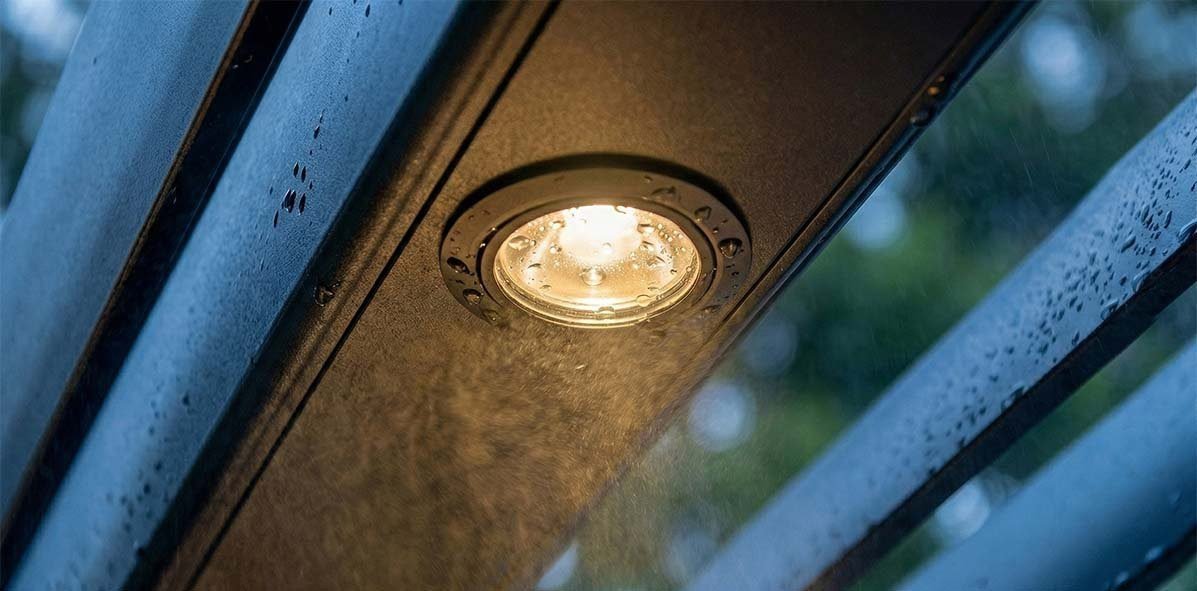
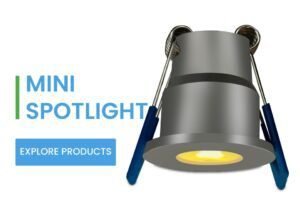
For an exposed surface-mounted spotlight, an IP65 fixture is normally a rational baseline, provided the cable exits downward or has a drip loop, the mounting surface does not trap water behind the housing, and the connector remains protected. A downward-facing fitting beneath a genuinely sheltered roof may not need the same rating as a spotlight mounted on the weather side of an open pergola. Treat the two positions as different products in the bill of materials.
For recessed fixtures, the cutout is part of the weatherproofing design. A gasket seals only as well as the substrate, cut quality, compression, and fastening. Timber movement, composite decking expansion, or a rough powder-coated metal cutout can compromise that seal. Specify cutout tolerance, gasket material, cable exit direction, and the drainage route below the light. Our recessed deck-light cutout and waterproofing guide is a useful companion when a project relies on a flush installation.
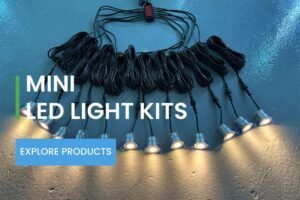
For brands building a coordinated pergola or landscape range, it is usually more reliable to qualify a compatible fixture, cable, splitter, driver, and control approach as one kit. VLED has developed mini-lighting solutions for pergolas and outdoor projects, including IP65 mini LED spotlights and low-voltage kits. This lets a buyer review the full connection path rather than assuming that individually rated parts become an equally rated assembly.
Deck and step lights need drainage design as much as ingress protection
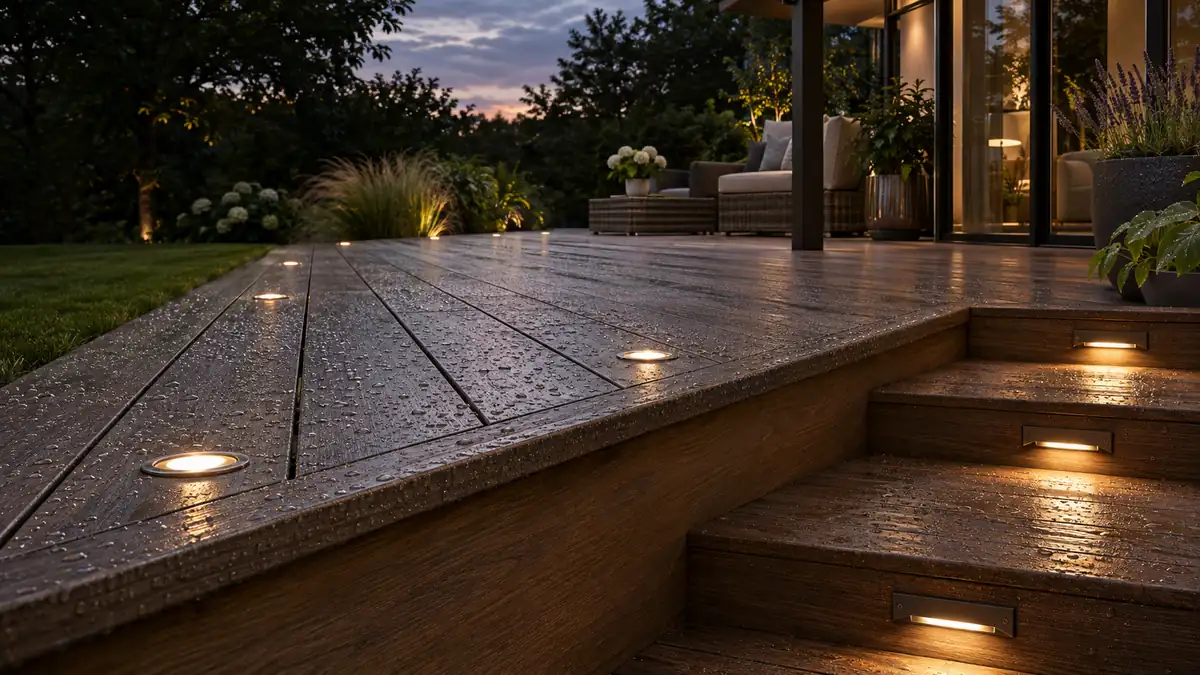
Deck lights fail in a different way from wall-mounted spotlights. The water challenge is not only rain striking the face. It is water held in a recess, pushed through a joint by foot traffic, or entering a cable channel below the deck. A flush lens at the lowest point of a board can see repeated immersion after every storm, even if the fixture is described as “for outdoor use.”
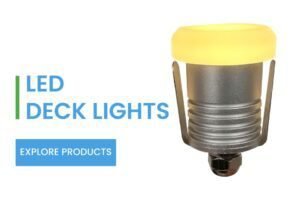
For surface-mounted deck and step lights, keep the cable entry below the fixture or behind a protected service void, and avoid a horizontal gland that becomes a small reservoir. For recessed lights, form a drainable cavity rather than a sealed bucket. The installer should be able to inspect and replace a connector without lifting a large area of finished decking. If irrigation heads, snowmelt, or leaf-blocked drainage can create standing water, specify for that event rather than for a normal dry day.
For a product range, state the IP rating of the fixture and the rating or location requirement of every supplied connection separately. This is particularly important for deck-light kits. A buyer comparing 12 V and 24 V should also plan cable runs, voltage drop, driver placement, and enclosure protection; this 12 V versus 24 V deck-light guide explains the system-level trade-off.
For LED strip lights, the weakest sealed point wins
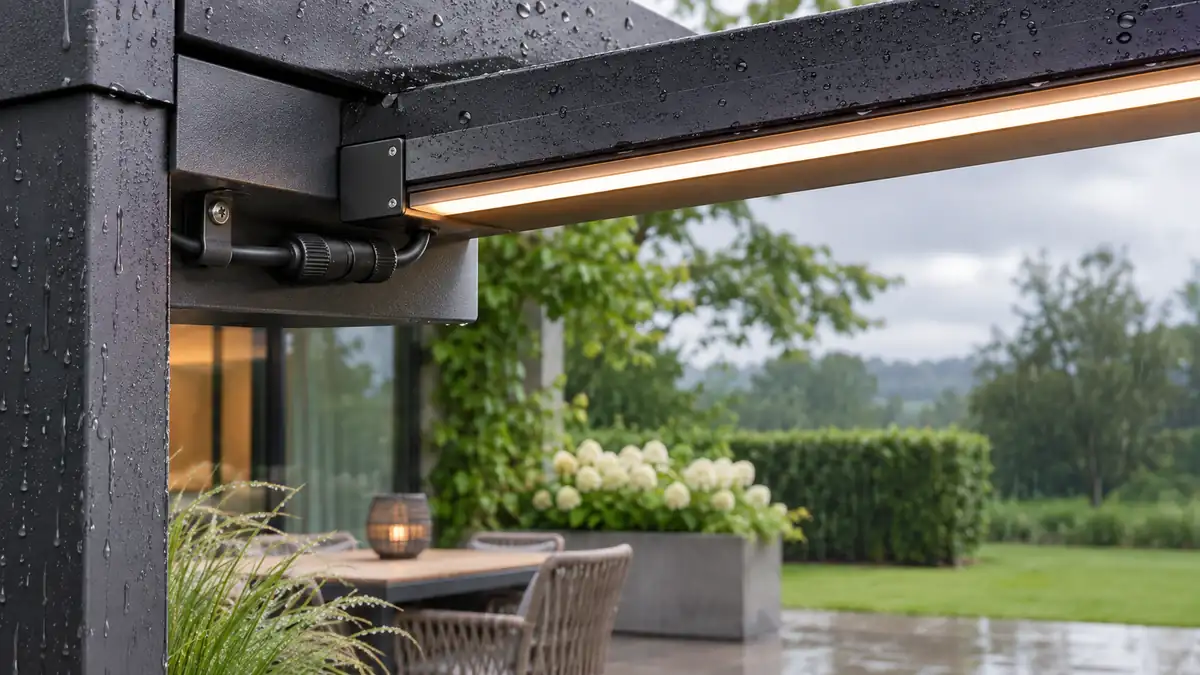
Outdoor strip-light listings can make IP selection look simple: IP65 for rain, IP67 for temporary immersion, IP68 for continuous immersion. That summary is useful only when it describes the final, installed run. A silicone-coated strip may carry an IP65 claim while a cut end, power injection point, controller lead, or connector is left unprotected on site.
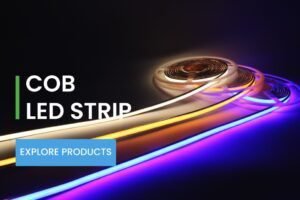
For a pergola cove, soffit, or protected patio detail, IP65 strip lighting in an aluminium profile can be an effective design if the ends and feed are sealed to the same intent and the profile has a thermal path. For a ground-level edge or area where water pools, an IP67 construction may be more appropriate, but only when the joints are made with compatible, properly sealed components. For permanent immersion, choose a purpose-designed IP68 product and obtain the declared operating conditions in writing. Never infer submersion suitability from a tube alone.
Coating and sleeving also affect light output, bend radius, serviceability, and heat transfer. Select them with the LEDs, profile, diffuser, power density, and run length in view. For more detail on this narrower subject, link buyers to IP65, IP67, and IP68 LED strip lights for outdoor projects and to the practical analysis of why outdoor LED strip lights fail. Those resources address the strip-specific choice; this guide keeps the decision focused on the complete lighting system.
A seven-question IP review for brands, importers, and project teams
Before approving samples or issuing a purchase order, ask the supplier to answer these questions for the actual SKU, not for a similar family product.
- What exactly was IP tested? Ask whether the test covered the completed luminaire, a bare strip, the connectorized assembly, or a particular cable configuration.
- Which standard and test report support the claim? Request the rating, test basis, report traceability, and any declared IP68 depth or duration.
- What is the weakest supplied part? Identify fixture, driver, controller, splitter, plug, cable gland, cut end, and power-injection point separately.
- What does the installation instruction require? Confirm orientation, cable loop, drain hole, mounting substrate, recess depth, and restrictions on immersion or washdown.
- How is heat managed? A fully enclosed small fixture or strip system still needs a credible thermal path at the intended ambient temperature and duty cycle.
- What environmental exposures sit outside the IP code? Review UV, coastal salt, fertiliser or pool chemicals, impact, freeze-thaw cycling, and cleaning methods.
- Can the installer service the system without breaking its protection? Specify accessible junctions and replacement routes. A light that cannot be serviced becomes a future site failure.
For private-label or OEM work, add those answers to the specification and sample-approval record. VLED’s OEM mini LED spotlight specification checklist can help turn broad requests such as “waterproof pergola spotlight” into measurable choices: IP class, voltage, beam angle, colour temperature, housing, cable, control, and packaging. That is where an outdoor product range becomes repeatable rather than merely saleable.
Common IP rating mistakes that create expensive outdoor-lighting claims
Calling IP65 waterproof in every context
IP65 is a strong outdoor rating for dust and water jets, not a guarantee against an installation that holds the luminaire under standing water. If temporary submersion is plausible, investigate the actual water depth, duration, and drainage rather than relying on a broad “weatherproof” statement.
Specifying the fixture but ignoring the power supply
Drivers and controllers often sit in roof cavities, under decks, or inside cabinets. Their location, enclosure, ventilation, and cable entries need their own environmental specification. A suitable fixture cannot compensate for an unsuitable power component.
Assuming a connector preserves the luminaire’s IP rating
A connector can only perform at its stated rating when it is fully mated, correctly assembled, undamaged, and used as instructed. An unplugged lead, an unsealed field cut, or a connector resting in a wet cavity changes the result immediately.
Using IP as a substitute for material selection
Coastal patios, pool decks, and irrigated gardens introduce corrosion and chemical exposure. A high IP rating says nothing about stainless grade, aluminium finish, gasket chemistry, or UV stability. Include material and finish requirements alongside the ingress rating.
Frequently Asked Questions
Is IP65 good enough for outdoor LED spotlights?
Often, yes. IP65 is a practical baseline for an exposed outdoor spotlight that will receive rain and spray but is not expected to be submerged. Confirm the cable entry, connector, driver location, mount drainage, and the manufacturer’s installation limits before treating the complete system as IP65.
Do recessed deck lights need IP67 or IP68?
They may. The correct rating depends on whether the cutout can retain water and for how long. A drained, protected recess has a different exposure from a low point that floods after rain. If standing water is credible, use a product designed for that condition and follow its drainage requirements.
Is IP68 always better than IP67?
No. IP68 depends on manufacturer-declared immersion conditions, while IP67 has a defined temporary-immersion test. Compare the exact declaration, including depth, duration, cable arrangement, and whether the claim covers the complete assembly. Choose the rating that matches the real exposure, not the larger-looking number.
Can I use an IP65 LED strip under a pergola?
It can be suitable when the pergola detail protects the installation from pooling water and the cut ends, feeds, connectors, drivers, and controls receive equivalent protection. Plan the thermal path and service access as well. The strip’s rating alone is not a rating for the installed run.
Specify the water path, then specify the light
The best IP decision begins with a simple question: where will water go when the site is at its worst? Follow that path through the fixture face, mounting detail, cable, connection, driver, and enclosure. Then select the rating and system architecture that make that path safe and serviceable.
That approach produces fewer ambiguous specifications, more defensible product claims, and fewer returns after the first hard season. For a custom pergola, deck, landscape, or private-label lighting program, VLED can help translate the intended installation into a coordinated mini-spotlight, deck-light, strip-light, cable, and control specification. Contact VLED to discuss the outdoor lighting system your customers will actually install.
Send Us Your Request